Tag Archives: writing

Hecuba

Sometimes, reality is stranger than fiction and my dealings with this iconic, archetypal figure from Greek Tragedy has made the transition from Troy to Campbells Creek in a most significant way. Some eight years ago I had the privilege of performing the lamenting queen on Hydra, Greece where my passions for both Greece and Greek Tragedy were melded into performance. _

Since that time, in a similar vein to Queen Hecuba,

‘My destiny has changed. I must endure it. Sail with the currents wherever fate may lead.’

Fate came with the task of building a home in Campbells Creek, Victoria. From a metaphysical point of view, this could be seen as an action of a woman building her own domain. I too, like Hecuba had been bereft of security and as a single woman, the ability to build my own dwelling, my security, came as a challenge that one would view on television building programmes.

Again, like Hecuba, I was in a strange land. People had different customs. The milieu was unlike my previous experiences and with the onset of COVID, I found myself alone. Aloof, and relatively reclusive. I referred to myself as the constant gardener a role devoted to the glory of Gaia to restore the earthly damage of the gold rush to rejuvenate and reinvigorate the healing qualities of nature. Also, at this time my acting agent closed her doors and with that a near 60 year career on stage, TV and film ostensibly ended.

‘What will come of me?’ was Hecuba’s cry as she ‘foundered on this miserable rock.’

Unlike time in a theatrical production which is finite with a beginning, middle and end, time in reality is endless and decidedly unpredictable. Please imagine my surprise when I was contacted by Greek Theare Now Artistic Director, Michael J. Smith asking me to audition for the role of Hecuba in an upcoming production Of The Trojan Women in Canberra, A.C.T. Of course my heart jumped and quite studiously and ardently I began memorising Hecuba’s opening speech with dedication and total delight. Then just as suddenly, the invitation was rescinded. They had decided not to do the play. A decision based on the dreariness and endless lamenting qualities of the piece and the likely failure to draw an audience.

My disappointment was not for me the actor doing it but rather my saddness that the play would not be staged Now as I consider it to be the most potent and important work for our time. Reflection on the symbology of Hecuba, the women, displacement, lament and grief naturally aligned with all the war-torn locations on our planet and the misery, resilience, sacrifice and wonder of all women and their children.

And that ‘I, like a mother-bird guarding her brood will lead the lament.’

From this experience has emerged the notion of Project Hecuba.

Hecuba the Queen who leads the lament. The voice of wisdom that bridges loss and renewal. The physical sound that shatters psychic grief and offers hope.

Hecuba is our Queen for Now.

The notion of the Hecuba Project is for conscious women to raise their voices for the collective. A sound, a poem, a drawing, a piece of music. Anything that expresses grief. lament, hope.

There may be small circles doing a small ritual. There could be podcasts of women’s stories. There could be a website to link the possible. With these random ideas, the purpose of this blog post is to get the notion of Hecuba in the Now out there. And of course to invite like minded souls to engage.

Please consider the Hecuba Project and if you resonate to it, let’s begin! Let’s make the sound for the planet, for humanity, for women everywhere.

LET’S MAKE HECUBA LIVE.

Please send your expression of interest to brendaaddie@gmail.com.

Spoleto Festival, Italy.

See the World and See World Theatre

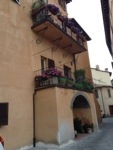
Spoleto, set high in the hills of Umbria couldn’t represent a greater contrast from Greece. Arriving in this Roman town with it’s winding streets, tall stone buildings, magnificent architecture, plazas, and beautiful pot plantings on a busy Sunday afternoon, one was struck by the sophistication of the place boasting one of the finest art festivals in the world. Spoleto, The Festival of Two Worlds. The bunting promotion in association with Mercedes Benz in the central plaza states ‘ Art or Nothing.’
A browse through the historical literature reveals that the city has a pre-Roman existence going back to the 10-11 century BC. It was a colony in 241BC and a municipium in 90BC.
In the light of this knowledge I am interested to trace the origins of the local ampitheatre to explore the theatre productions which took place here. A small Roman theatre abuts my hotel.
Please forgive my getting so absorbed in my research that I tend to overlook expressing the sublime beauty of the countryside. The light here is soft and often hazy and on several occasions there has been afternoon thunder and light rain. The sophistication of the place extends to the attire of the locals. They are so well turned out. Even the young concierge in the hotel looks like he has stepped out of a high couture journal. Magnifico!
Women are highly adorned with jewelry, impeccable make up and casual doesn’t seem to be part of the dress code. I wonder how they manage the cobble paving in their smart shoes…
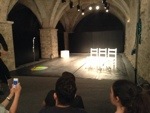
I had intended to have a little rest in Spoleto after the somewhat hectic pace in Athens and the plays I have chosen to see are well spaced throughout the week. However, as always, I couldn’t help myself, and on Day 2, I found myself at an exhibition production of the European Youth Theatre featuring students from the Conservatoire National Superieur D’Art Dramatique. It was a dramatic adaptation of Dostoyevski’s 1877 short story,The Dream of a Ridiculous Man.
The play took place in a crypt of one of the many churches and grand public buildings. I hope the photo shows the beauty of the vaulted ceiling.
It’s always good to support newcomers to the craft and throughout the festival, Spoleto provides the opportunity for European Acting Academies to present their talent. As well as encouraging new talent, I always make a determined effort to see I work I don’t know, as was the case with this Dostoyevski. It’s about his realization, since a small child, that he was ridiculous and that ultimately there is nothing worthwhile in life and therefore he must commit suicide.
Presented as a 3-hander, by the plays’ end the actors had managed to seduce sufficient numbers of the audience to take their places in the playing space, and then exiting, thus making them (the audience/everyone/ tout le monde) ridiculous. Being in French it was relatively easy to follow the narrative.
Back at Hotel dei Duchi for dinner, I’m watching the palest of sunsets disappearing behind the Umbrian mountains. The Golden Hour has been magical and the light here is soft an enchanting. It is a soft landscape particularly after the ruggedness of Greece. The light is more gentile and the sun
a little kinder.
Once more, I am reminded of my thesis and how art, whether theatre, painting, music, dance, literature and even cinema, is born out of place. I’m very excited to explore Spoleto and the festival offerings. Clearly it is a very important event in the year and as yet I’m having difficulty in identifying the locals from the art lovers coming from afar. There is so much going on in a quiet and unassuming way, everywhere you turn you find plazas set up for events, some of them free and at all times during the day and evening. Some events are even out of Spoleto in the countryside.
Finally, I feel compelled to make a comment with regard to a comparison of the Spoleto Festival we used to have in Melbourne,which from my memory was more of a street festival. This is not the case in Umbria.

20130710-182024.jpg
20130710-182114.jpg
20130710-182141.jpg
20130710-182209.jpg
20130710-182358.jpg

Spoleto Festival, Italy.

697 words, 4 minutes read time.

Last edited 12 years ago.

Status

Publish

Slug

Author

Discussion

Revisions

6

Parent

  • Page