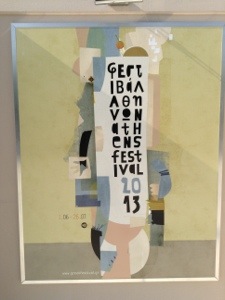
Athens and Epidaurus Festival, 2013 + Ionesco’s Rhinoceros

gjd;v h;voi;
Athens Epidaurus Festival, 2013

DAY 1 of this tour and already I’ve broken the premise of exploring the history and development of theatre by seeing Ionesco’sRhinoceros at the Onassis Cultural Centre. Of course Ionesco is renown for Absurdist Theatre and when one gets the opportunity to see a French theatre company performing in the original language as part of the Athens Epidaurus Festival, I firmly believe the variation in the thesis can be justified with a view to future research in the Post Modern period when perhaps one can travel to Paris and Ionesco’s native influences and explore his perceptions of Nazism and Facism that gave inspiration to this marvellous piece of theatre.
The atmosphere in the Onassis Cultural Centre was palpable. The building itself is a wonderful monument to cultural philanthropy and the show appeared to be a sell out. The production values, so often overstated for this work, relied mostly on the mechanics of a set that could move and heave as the drama unfolded to a point where the extreme 45 degree angles of the office playing area, had the characters clinging on for dear life: a perfect metaphor for the piece. Also extraordinary was the beautifying of the rhinoceros revealed in a picture portrait centre stage to perfectly reflect the idolatry associated with this peculiar Other.
Perhaps as an Antipodean I have never experienced the reaction of an audience with at least 20 curtain calls. All of which were executed with the fine precision and attention to the work of the ensemble as a whole. That the play was delivered in French with Greek sur-titles did not impede the pleasure. This was truly an example of how great drama, like opera, can overcome perceived language barriers.

 Emmanuel Demarcy-Mota Eugène Ionesco, Rhinoceros 30 June - 1 July, 21:00 Onassis Cultural Centre

Emmanuel Demarcy-Mota
Eugène Ionesco, Rhinoceros
30 June – 1 July, 21:00 Onassis Cultural Centre
Related articles

Athens and Epidaurus Festival, 2013 + Ionesco’s Rhinoceros

322 words, 2 minutes read time.

Last edited a few seconds ago.

Status

Publish

Slug

Author

Discussion

Parent

Athens Day 3

SEE THE WORLD AND SEE WORLD THEATRE

ANTIGONE at the Benaki Museum

I have heard it said that many theatre lovers become despondent when the Ancient Greek classics are reinterpreted. And despite my desire to also see a grand chorus and Tiresius making his sightless entrance, this production, with just 6 actors sans Tiresius, was a well executed representation of societal limitation. The architecture of the museum Atrium was intrinsic to this notion with floor to ceiling glass window frames boxing the frustrations of each of the characters. The grand chorus was a one – woman tour de force. Antigone was lithe and athletic in her earthy despair while Ismene was a tall, detached vision of loveliness in blue. Kreon, was huge in stature and in his delivery. For me, subtlety is always a winner but the audience seemed to enjoy his expansive gesture and vocal delivery. My handy ipad with the English text was not a success on this occasion as I had few pointers to connect to within the adaptation. Once again the audience appreciation was vast and it is apparent how greatly culture is revered in Greece. Indeed the Festival Director, in his opening gambit, suggests how culture eases hardship and reignites qualities of hope and beauty. He also comments on the deliberate choice to focus his festival on Greek content with Greek performers. Selfishly this pleased me enormously. The day was spent making the acquaintance of a dentist. My first bite into a Greek apricot meet with resistance from a molar. Sadly for me, the apricot won. Dr Theodoros Papadakis was a delight. The surgery, an aesthetic feast of works of art and interior design and he just happens to have the same name as my Theodore. As a theatre lover himself he was immensely interested in this project and was curious to get my impression of the local cultural content and appreciation which in turn elicited my admiration and a query as to whether it was just because of the festival. Not so, he assured me and spoke of the excitement surrounding the upcoming all-male version of Medea. I, too , am greatly looking forward to it as the finale to the Athens leg of this journey.

20130706-075723.jpg

Athens Day 2 Love and Intrigue

SEE THE WORLD AND SEE WORLD THEATRE

SCHILLER’S LOVE AND INTRIGUE

Today I explored the Acropolis and despite the heat and the hard the climb, one is humbled by the achievements of the Ancient Greeks and the truly awesome expression of excellence in architecture and religion. For me the highlight was sitting in the Theatre of Dionysis – the birthplace of Western Theatre. Also on the Acropolis, is the Odeon of Herodes Atticus which symbolizes the next phase in the development of theatre – that of the Romans. Sadly for me the festival programmes showing at the Odeon while I am here are showcasing contemporary singers and other genres that are not part of my thesis. So instead I went to a production of Schiller’s Love and Intrigue. While this is an 18 century German text, my reservations about the language for a modern audience were totally dispelled by the adaptation of the piece into Greek tragedy. The adaptation was superb and ticked all the boxes for the elements of Greek Tragedy while the delectable sounds of the Greek language translation coupled with Greek emotional sensibilities enlivened the piece significantly.

The setting for the production was a great adventure to an industrial area of Athens where a factory complex was turned into a theatre space. The sparseness of the set and mere suggestion of German period costume were ideally informed. The playing of a complex plot with many characters was executed by just 2 female and 4 male players all of which was handled with perfect suspension of disbelief including a beautiful mime sequence which served as a prologue to the piece as the audience entered the auditorium. For me, a non Greek speaker, I tested out the use of my iPad with an English translation of the German text and page turning as the play went on. It worked marvelously and knowing the plot and the characters, I could quickly skip through the cuts and doubling of characters. In all it was a very worthwhile experience including the festival’s consideration in supplying a bus to return patrons to the Athens city centre. This was followed by a short walk on a balmy evening back to my hotel. Another really great day of seeing the world and seeing world theatre.

The Theatre of Dionysis

Fuenteovejuna by Lope de Vega

Placa en la Plaza Mayor de Almagro
Placa en la Plaza Mayor de Almagro (Photo credit: elarequi61)

This evening I finished reading this extraordinary play in a dual language version.  Regarded as Lope’s most famous work, it is a tale of honour and the power of the common people.  Quite apart from the poignancy of the piece amongst brutality and even The Rack, the setting of the play in the Almagro /Ciudad Real area of Spain is of great interest as it is where I will be seeing a representation of the work at the Almagro Festival.

Lope de Vega, like Shakespeare, incorporated historical occurrences in his writings and for anyone lacking in the finer detail of Spanish history, the translator of the text, Stanley Appelbaum (Dover Publications) provides a comprehensive background to the work and  a fine account of Lope de Vega‘s poetic form.  This read has been an enriching experience and confirms the notion of theatre belonging to place. How greatly I am looking forward to seeing this work in its authentic environment even if it is some 600 years on and with postmodern dramaturgy.  Incidentally, according to Appelbaum, Lope de Vega wrote Fuenteovejuna between 1611 and 1618 and the actual incident occurred on 22 and 23 April, 1476.

The play is colourful, humourous and immensely rich in medieval chivalry. I highly recommend it.

Travel Frenzy!

Only 27 days to go before I’m on the plane to Athens! I’m in a travel frenzy organising iphone and ipad communications and theatre reservations.

Athens: 5 shows in 6 days including Antigone, Iphigenia at Aulis and best of all, Medea, at the Ancient Theatre at Epidaurus. My 3 favourite plays that happen to be about women.

Spoleto: Because theatre in Rome is closed for the summer I decided to head north to Umbria and although it is not in my plan of tracing theatre history chronologically, there is some not-to be-missed theatre such as Robert Wilson‘s The Old Woman and Irina Brook‘s, Island Trilogy. Some times one can just get lucky!

But another stroke of luck, I did find classical Roman theatre in Spain. So as well as doing the Almagro festival I will head over to Merida for a production of The Golden Ass by the second century author,  Apuleius. It is the only Latin novel to survive in its entirety. Please check out the Roman ampitheatre it’s extraordinary!   http://www.spain.info/en/reportajes/teatro_romano_de_merida_el_ultimo_refugio_de_las_musas.html

Finally thanks to Pan Australian Travel for being so accommodating to my theatrical whims.  http://www.panaustravel.com.au

English: Illustration of the Golden Ass by Jea...
English: Illustration of the Golden Ass by Jean de Bosschère. (Photo credit: Wikipedia)