All posts by brendaaddie

Antigone by Brenda Joy Addie

ANTIGONE — a work in emergence

Last week I held a private reading of Antigone, a one-act play written and directed as part of The Hecuba Project: Voices of Grief, Seeds of Hope.

The work reimagines the ancient archetype of Antigone in a contemporary setting, retaining the chorus, ritual structure, and moral ferocity of Greek tragedy while speaking directly to women’s lived experience today.

This reading was not a performance but a listening: a chance to hear the language in the body, to test rhythm, breath, silence, and choral force. The work is still evolving — as all living theatre must — but it has now spoken clearly enough to begin its journey into the world.

Antigone is written for minimal staging and outdoor or in-the-round performance. It is conceived for intimate amphitheatres, small halls, and resonant public spaces where voice, presence, and audience proximity matter.

The full script is available on request for programming, production, or festival consideration.

More to come.

Hecuba Rising

Well we know that truth is stranger than fiction. Thankfully the energy of truth has a synchronicity that traverses the universe in its own way, in its own time and lands in precisely the perfect way. The Hecuba Project is reflective of such energy and has begun to gather a momentum that brings form and identity to the Hecuba archetype.

No longer just an idea, The Hecuba Project has received many submissions from women choosing to include their expressions in the collective fruit bowl of ‘voice’.

Voice/expression comes in many forms: written expression in poetry, essay, reminiscence, reflection, playwriting. It also comes in drawing, painting, photography and quilting and gardening and magic and ritual. Indeed Hecuba lives!

Together we have embraced our Queen of Lament and brought her forward to become our Queen of Hope.

As our project grows even more, we look forward to harnessing the voices in gatherings, festivals, performances and publications.

We welcome all to explore the energy of Hecuba in the 21st century. With her continuing grace and direction for all women throughout our world, no woman is alone. Hecuba guides and leads us to become the Seeds of Hope. And so it is.

Hecuba

Sometimes, reality is stranger than fiction and my dealings with this iconic, archetypal figure from Greek Tragedy has made the transition from Troy to Campbells Creek in a most significant way. Some eight years ago I had the privilege of performing the lamenting queen on Hydra, Greece where my passions for both Greece and Greek Tragedy were melded into performance. _

Since that time, in a similar vein to Queen Hecuba,

‘My destiny has changed. I must endure it. Sail with the currents wherever fate may lead.’

Fate came with the task of building a home in Campbells Creek, Victoria. From a metaphysical point of view, this could be seen as an action of a woman building her own domain. I too, like Hecuba had been bereft of security and as a single woman, the ability to build my own dwelling, my security, came as a challenge that one would view on television building programmes.

Again, like Hecuba, I was in a strange land. People had different customs. The milieu was unlike my previous experiences and with the onset of COVID, I found myself alone. Aloof, and relatively reclusive. I referred to myself as the constant gardener a role devoted to the glory of Gaia to restore the earthly damage of the gold rush to rejuvenate and reinvigorate the healing qualities of nature. Also, at this time my acting agent closed her doors and with that a near 60 year career on stage, TV and film ostensibly ended.

‘What will come of me?’ was Hecuba’s cry as she ‘foundered on this miserable rock.’

Unlike time in a theatrical production which is finite with a beginning, middle and end, time in reality is endless and decidedly unpredictable. Please imagine my surprise when I was contacted by Greek Theare Now Artistic Director, Michael J. Smith asking me to audition for the role of Hecuba in an upcoming production Of The Trojan Women in Canberra, A.C.T. Of course my heart jumped and quite studiously and ardently I began memorising Hecuba’s opening speech with dedication and total delight. Then just as suddenly, the invitation was rescinded. They had decided not to do the play. A decision based on the dreariness and endless lamenting qualities of the piece and the likely failure to draw an audience.

My disappointment was not for me the actor doing it but rather my saddness that the play would not be staged Now as I consider it to be the most potent and important work for our time. Reflection on the symbology of Hecuba, the women, displacement, lament and grief naturally aligned with all the war-torn locations on our planet and the misery, resilience, sacrifice and wonder of all women and their children.

And that ‘I, like a mother-bird guarding her brood will lead the lament.’

From this experience has emerged the notion of Project Hecuba.

Hecuba the Queen who leads the lament. The voice of wisdom that bridges loss and renewal. The physical sound that shatters psychic grief and offers hope.

Hecuba is our Queen for Now.

The notion of the Hecuba Project is for conscious women to raise their voices for the collective. A sound, a poem, a drawing, a piece of music. Anything that expresses grief. lament, hope.

There may be small circles doing a small ritual. There could be podcasts of women’s stories. There could be a website to link the possible. With these random ideas, the purpose of this blog post is to get the notion of Hecuba in the Now out there. And of course to invite like minded souls to engage.

Please consider the Hecuba Project and if you resonate to it, let’s begin! Let’s make the sound for the planet, for humanity, for women everywhere.

LET’S MAKE HECUBA LIVE.

Please send your expression of interest to brendaaddie@gmail.com.

Reflections on Departures

This day is peaceful and sunny. Birds are chirping and the garden is watered in preparation for the thirty degree day. And as I pull atrophied plants from their spring places of glory, I can’t but reflect on the wonder of nature. The certainty of it and its constant desire to grow, to be beautiful, to endow and then quite graciously end. As humans we regard endings with sadness and grief and often I feel that way when a plant, a flower, a vegetable, leaves me. So what do I do? I dig over the soil, wait a bit and start over.

Today my sadness and rejoicing is at the imminent departure of a dear and beautiful plant known in the human world as Jack Youens. We were children when we met. We danced, we sang, we acted together. We cared for each other during our adventures in London. We grew up and lived in different cities, but always the spirit, the kindness and the creativity of this man has remained deep in my cellular constitution. So dear Jack, my flower of peace and beauty, I look forward to when we plant another garden with freshness, vitality and colour within the graciousness of whatever it is that makes things grow. My love to you dear one and thank you for you.

Well, well, well.

Here it is almost spring. I say almost because it is late August and thrillingly colorful blossoms are enlivening our street scapes and gardens. Heavy rain storms have knocked over the daffodils and with the sun just breaking through hopefully the daffodowndillies will resume their upright positions as the harbingers of warmth and more importantly, colour, after the drabness of winter.

In my newly appointed role as the Constant Gardener, I have already ventured out of doors this morning to firstly survey the wonder of the new day and to marvel at the plants and secondly to take advantage of the dampness of the soil to weed. Weed, weed, weed. I smile as I do so and wonder just why I am doing it. Is it just because it is spring? Are weeds just plants out of place? Darned if I know but all over the driveway and terrace there are little piles of weeds waiting to be relegated elsewhere. I really love the look of the property without the weeds and I love that the errant plants can be usefully housed elsewhere.

Also this morning I found masses of unwanted bluebell plants forcing their way through the rough and tumble backyard bank that had been decimated by the fall of a tree. During its recovery the bank has become a site for other garden refuse and yes, for the discarded bluebells from a friends suburban garden. My happiness transplanted me to fields of bluebells in UK fields under mighty oaks – a very far call from their surfacing from under pig face cuttings and weeds. But yes, there is the likelihood of a mass of bluebells sometime soon.

So what is this post about? I guess it’s about gardening and being a regional Victoria Septuagenarian in 2024. It’s a curious experience after a life of work, travel, theatre, film, television and the academy. From thebtime when gardening was the past tine and now, thankfully, gardening is the main endeavour. But no robust British soils here. No forests of oak. Just gentle nods to northern hemisphere spring by a lucky daffodil, a few mangy grape hyacinths and the hope of fragrance from a patch of self sown freesias.

So it would appear that this might be my gardening journal. Already I’ve investigated how to grow carrots and discovered that seedlings don’t transplant! So what to do with a tray of carrot seedlings? Stay tuned!

My other unresolved query today is about the kangaroo poo in straw that I’ve been gifted from the native animal shelter. I think of the Findhorn Garden and the notion of accepting everything that comes to your door. I also think of the mother kangaroo with her pouch-peeping joey that I encountered on my morning estate ramble. A sign of the usefulness of kangaroo refuse?

Signing off now, until next time. And ….

Greek Theatre for Now

GTforNow

SALON OF BIG IDEAS – Central Goldfield Libraries: Bendigo and Castlemaine.

It’s not everyday a theatremaker gets the opportunity to wax on about their passion but clearly the stars were in alignment for me when I spoke at not one, but two, Central Goldfield Libraries’ Salon of Big Ideas.

My understanding is that the Salons developed from previous conversations in philosophy, which so sparked local interest that participants requested widening the field to include a broader sweep of subject matter.

As Greek Theatre is often regarded as somewhat esoteric, please imagine my delight when 30 people registered to attend the talks. Entitled Greek Theatre for Now, the idea of my presentation was to ‘weave the classic narratives of Homer … into a modern day context … [and to consider] how classic Greek theatre narrative has a place in current day issues of war, displacement, democracy and women’s rights.’

Having recently returned from Hydra, Greece, where I performed in The Trojan Women, the notion of displacement, war, women’s rights and democracy were very real considerations to me. Not only in the play, but more importantly in the light of the hundreds of Syrian refugees making their way to the Greek Islands to start a life somewhere else.

Moreover, I was concerned by my perception of the broad-scale apathy Australia has displayed towards refugees. How can we forget that in every face, there is a story of great suffering? For I strongly believe that no one leaves their home unless truly forced to do so.

Rolling back the historical clock to the Trojan War where men died and women were the spoils of war, it seems to me that little has changed. Do we really know what happens in modern day warfare? Is the story we see on the news the real story? And whose story is it? And what of the other story? Only today I saw more reports about the atrocities in Myanmar. How does this still happen in the twenty-first century?

It was from these questions that the notion of Greek Theatre in a modern day context was born. For throughout the narratives of Greek Tragedy we can still see the stories of loss, suffering, matricide, rape, filicide, violence, war, abduction, enslavement, sex, mayhem, cannibalism, revenge, murder, human sacrifice patricide, etc. etc. It could well be the stuff of modern day movies and television. So what has changed? Only the time and the place.

My many trips to Greece, specifically to see Greek theatre in situ, had enabled me to experience a sufficient number of plays to start to evaluate their agency in a modern setting. Together with that first hand experience and a good knowledge of the texts, I became quite obsessed to share my passion and to find out if others were interested in the ongoing value of the western world’s most enduring performing art form.

From the attendees, eleven people have elected to ‘keep the conversation going’ and we will embark on a series of discussions over the next few months. Furthermore, five people have expressed interest to join my All The World’s A Stage Theatre Tours trip to Greece in 2019. (www.worldtheatretours.com)

I feel totally enheartened that there is an audience for this material. Not only does it begin to create a groundswell of interest in Classical Greek theatre but it forces us to evaluate what it really contributes to our contemporary world. And how it can make a difference.

Already I’m aware of one international rehabilitation programme that uses Sophocles’ Ajax as its springboard; that an adaptation of Euripides’ Trojan Women, Queens of Syria, (Syrian Refugees & Trojan Women) was recently staged in Jordan, and of equal importance, Yannis Simonidis’ theatrical discourse, Socrates Now has travelled to over 20 countries around the world.  I see these as glorious beginnings.

In conclusion, I invite anyone with knowledge of other significant applications of the works and/or with ideas as to how to further these conversations, to respond to this blog and become an active voice in Greek Theatre for Now.

Brenda Addie.

April, 2018.

GTforNOw5


Selected C.V.

MASTER OF CREATIVE ARTS (THEATRE STUDIES) UNIVERSITY OF MELBOURNE

POST GRADUATE DIPLOMA (THEATRE STUDIES) UNIVERSITY OF MELBOURNE

ADV DIP SCREENWRITING FOR FILM TELEVISION AND DIGITAL MEDIA, RMIT

LECTURER AND TUTOR ARTS MANAGEMENT AND THEATRE STUDIES, UNIVERSITY OF MELBOURNE

MEMBER UNIVERSITY OF MELBOURNE THEATRE BOARD.

2017 Actor – The Trojan Women – Hydrama, Greece.

2016/17 – Writer/Director – There’s Nothing Like a Dame – Beleura House, Mornington

2016 Director – Breathing Corpses by Laura Wade, Melbourne Fringe.

2016 Dramaturg/Director/Actor – The Magic Pudding, Beleura House, Mornington

2013 Director – The Tragedy of Lucrece by Enzo Condello, Melbourne Fringe 13

2012 Director – Yes, Yes, Yes!, Bloomsday in Melbourne, Trades Hall

2011 Director – An Irishman and a Jew go into a Pub… Bloomsday in Melbourne, Open Stage Theatre

2011 Director – Tango Femme by Merilee Moss, Carlton Courthouse

2010 Director – Carnivale of Nighttown, Bloomsday in Melbourne, Trades Hall.

2010   Actor – The House of Bernarda Alba (Bernada) – Northcote Town Hall Studio

2009   Director – The Servant of the Revolution by Anitra Nelson, Moreland Performing Arts Centre.

2009   Director – Wilde About Joyce, Bloomsday in Melbourne, State Library of Victoria.

2008   Director – Black Eyed Susan, Short and Sweet, Arts Centre.

2008   Director – Brave New World, Bloomsday in Melbourne, Melbourne Museum and Dubbleinit Roaratorio, Monties.

2008      Performer Seven on the Edge by Elissa Goodrich physical theatre based on Lorca’s Blood Wedding, Open Stage Theatre.

2007   Director – The Knitting Circle, Short and Sweet, Arts Centre.

2007   Producer, Triangle Theatre Company, Coventry U.K. The Last Women

2006   Director – Joyce’s Fall into Language, Bloomsday in Melbourne McCulloch Gallery, Melbourne.

2006   Actor– From the Maude Gonne Diaries by Linda Weste, Open Stage Theatre.

2005   Director – Embalming the Dead Entertainer, Carlton Courthouse.

2005      Co –writer/Producer Quilting the Armour, Ned Kelly Siege Commemoration, Glenrowan, Vic.

2004      Writer – The Kelly Women in Performance (Working Title) for 2005 Ned Kelly Siege Celebration.

2004   Dramaturg/Assist Director – The Bottomless Lolly Jar – Fairy Trina Productions

2004   Dramaturg/Actor – The Master Builder by Henrik Ibsen for Chambers Theatre Company

2003   Producer Red Brown Rock, a short film by Aanya Whitehead

2003   Producers Assistant to Aanya Whitehead, Dreams for Life by Anna Kannava – responsible for casting, rights acquisition and production coordination.

2003   Co- Writer/Researcher Slava- the Eternal Flame documentary Music Arts Dance films.

2002   Writer/Researcher/Producer Global Echoes – Music Arts Dance Films television pilot.

2002   Producer, One Night The Moon DVD Special features

2002-2004   Project Development Manager and Film Festival Coordinator, Music Arts Dance Films.

2000   Assistant to Producers, Music Arts Dance films, for production One Night The Moon.

2000   Playwright – Planet Knox and The Eye in the Sky Kaleide Theatre, RMIT, producer/director Lynne Ellis.

1999   Stage Manager Reserved Seating Only La Mama.

1998   Co – Producer and Presenter Litrophilia Radio EARFM.

1998   Editor and contributor Far Away Places (CAE Publishing) A collection of short stories.

1990   Associate Producer Blues in the Night, Athenaeum Theatre Melbourne

1986   Associate Producer The Sooty Show, Alexander Theatre, Monash University.

STAGE CREDITS: ACTOR

The Trojan Women (Hydrama, Greece); The Magic Pudding (Beleura House & Garden); The House of Bernada Alba (Alterior Motive Theatre Co); Seven on the Edge (Open Stage Theatre); Under Mulga Wood (Monsalvat Players); The Master Builder (Chambers Theatre Co); Hair Today Gone Tomorrow (Women Working In Theatre); School (Melbourne Writers Theatre); Blind Salome (Universal Theatre); Lilac Time (U.K. Tour); Caught on the Hop (Summer Season U.K.); Two and Two Make Sex (Summer Season U.K.); Double Edge (U.K. and Canadian Tour); The Man of La Mancha, Aldonza (Worthing, U.K.) Darling Mr. London (U.K.Tour); Goldilocks and the Three Bears (Alhambra Theatre, Bradford); Don’s Party (Royal Court London); A Touch of Silk and The Dean Case (MTC Workshops).

TELEVISION CREDITS: ACTOR

Newton’s Law; Hactresses; Glitch; Winners and Losers; Thank God You’re Here, Chances Nine Network 1989-1991 Co lead, Barbara Taylor; Bellbird ABC 1973-1974 Co lead, Ginny Hill; Neighbours Network 10, 1991 – 6 weeks guest role, Bunny Lawson and another guest role in 2002; Blue Heelers 2002 & 2003; Good Guys Bad Guys; State Coroner; The Damnation of Harvey McHugh; Inside Running; Flying Doctors; Prime Time; All The Way; The Far Country; Emerging; Henderson’s Kids; Carson’s Law; Prisoner; Cop Shop; Cash & Co; Division 4; Ryan; Marion.

FILM CREDITS: ACTOR

The Cup; The Widower; Dalkeith; Evil Angels (Judy West); Father; Jigsaw; The More Things Change.



It’s all about Hydra & Acting to the Gods

Nothing can be more seductive than a Greek island with 40 degree days, sparkling Mediterranean waters, the tinkle of donkey bells and the prospect of acting to the Gods.

Enter 12 individuals from different parts of the world all with the same overriding passion – to perform Greek Tragedy.

The chosen play, Euripides’ The Trojan Women is set in the aftermath of the Trojan War and the assembled women are to be dispersed to Greece as slaves and the booty of a war fought over the infamous Helen. Whilst the collective issue is bad enough, when each of the women is contextualised as a mother, a sister, a wife, an artisan, the full horror of displacement becomes apparent.

Hecuba, the Queen of Troy, not only suffers her personal tragedies but doubly suffers the fate of her subjects.  Ellen McLaughlin’s 1995 adaptation of the Euripides work is a lyrical but painfully blunt account of the saga that leaves us heaving at the injustice of war. Men start wars (even if this one was over a woman) and ultimately it is the women who suffer.  It is a timely reminder of the refugees that daily cross from the Middle East to the Greek Islands on their way to find another way of life. Whether displacement is voluntary or enforced, surely the disruption is the same. While The Trojan Women can instigate strong opinions on war, women and refugees, Euripides sympathy is palpable and it would defy humanity to not be moved by this play.  Greek tragedy is said to be cathartic and it is my ardent hope that this play will continue to make a difference in the way the issue of displacement is viewed today.

Directed by Peggy Shannon, the images tell their own their own story.

Hydrama, on the island of Hydra, is a unique experience for theatre makers (Hydrama Theatre & Arts Centre)

Why theatre history?

Why Theatre History? is the title of David Wiles’ introductory chapter in the 2013 publication of The Oxford Companion to Theatre History.  It is a provocative title and an equally provocative question. Indeed, why does theatre history matter and why in this instance am I going  to the financial and intellectual bother to trace it? And above all what do I hope to gain from it?

Similiarly to one of the Wiles cohort’s response to the same question, I am doing it because I love theatre and I love finding more about the thing I love.  Mysteriously, theatre has become a raison d’etre and the theatre practitioner and teacher in me has reckoned that there is an audience of individuals out there who really do want to engage more with theatre than is generally available. That an appreciation of the history and development of world theatre can enrich and deeply satisfy the audience experience.  But this exploration is not just about famous writers, actors or directors doing their famous thing … it is also about place. And with place comes the signature, the colour, the richness of the work. Shakespeare is England, Cervantes is Castile, Chekov is Russia and Aeschylus is Athens.

This is not an armchair exploration this is also an expedition to travel to those epicentres of tragedy and comedy that have so enriched the narratives of world theatre.

In reality, it might take many years to cover the whole world and all aspects of world theatre, but then again, think of the performances one will have seen in Greece, in Spain, in Paris, Dublin, London and Kerala. All the world is indeed a stage…

So why this particular theatre history? Because it’s cultural, colourful, fun, romantic and it’s travel at its most exciting.  Please join me.

File:2007-05-10 Epidauros, Greece 5.jpg

Sophocles’ Ajax at Epidavros.

The day is incredibly hot and I’m sitting in the Athens bus terminal at Kifissos. It is the hottest place I remember with bus exhaust fumes and an open air arrangement with the bus exhaust fumes and an open air arrangement with the only protection being a roof. Even a venture into a terminal cafe turned out to be hotter inside than out. Like in all parts of the world, one wonders how people manage to catch the right bus and especially, me. My excitement is palpable as I’ve metro’d it into Omonia to buy a bus ticket this morning in case the theatre bus was full when I arrived at 5 pm and I couldn’t get on.

Understandably services and Festival programmes are being cancelled due to the economic situation and the Electra that I had booked from Australia for last night was cancelled due to an actress injury. How was I to know? Just lucky I guess. I went to the website to get the address of the theatre and there was the announcement – ‘more shows cancelled.’ It seems that several productions have not opened at all.

Tonight, however, I’m off to theatre heaven at Epidavros, hence my unmitigated excitement. I can overlook the heat, the chaos of the bus station and my uncertainty of getting there by just focussing on seeing the metaphorical ‘curtain’ go up on Ajax in four hours time. When I told the hotel receptionist I was coming to this event, she said, as she clutched her heart, ‘that is a sacred place.’ And that’s exactly how it feels – making that homage no matter what.

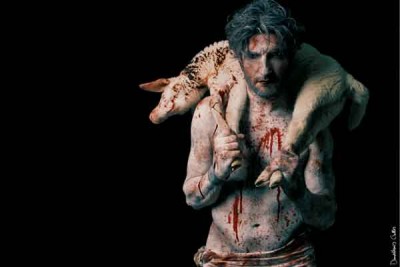
The theatre poster with a deranged and bloodied Ajax carrying a bloodied sheep is extraordinarily evocative and here I am now sitting on the nearly full Epidavros bound bus. Clearly there are many other classics lovers that are ready to share the experience. I’m also very happy that my exploration of all of Sophocles’ works earlier in the year familiarized me with this play and I’m very excited to see how Ajax unfolds on this hallowed stage.

Right now we have just passed over the Corinth Canal and the deep blue Aegean Sea is on the left of the bus. People are swimming, big cargo boats are doing their thing and I might even spot an inter island ferry. Quite perfect. To my right are the magnificent Peloponnese with the silvery green of the olive trees on the plain meeting the darker green of the conifers on the mountain and below there is the sea with random islands of random sizes jutting up at will.

On arrival at Epidavros, there is a bus driver announcement I don’t understand and I ask a travelling companion as to the content – 20 minutes after the play the bus with return to Athens. The responder is delightful, Magda, travelling with her mother, Sophia, and with whom I spent the rest of the evening, despite Sophia continuing to address me in Greek, as she doesn’t speak any English, whereas Magda is delightfully, totally fluent.

LX test for Ajax.
LX test for Ajax.

And now to the play itself, Ajax by Sophocles. In many ways this was the most traditional presentation of a tragedy that I’ve seen presented at this site. In the first instance, the players and musicians entered the space in a musically accompanied procession which was at once aurally arresting and visually appealing as they crossed the rear of the stage in half light in what could be regarded as an homage to Dionysus, or simply a way of attracting audience attention as in No theatre. Whatever the intention, it worked. The instrumentation was haunting, and although using what I regarded as contemporary instruments including a trombone, there was a true sense of lament and dramatic expectation. In keeping with the notion of what is believed to be the traditional use of music, song and dance in Greek tragedy, this was the first time I have ever seen it implemented. A ‘troubadour type’ of character playing a balalaika sang the prologue and some of the chorus speeches were also sung. There is a moment in the play when the chorus proclaims:
I would dance, I am bent upon dancing! …

Wild, high, excited dances, Mysian, Cnosian –

I would dance, I am bent upon dancing!

I found it a strange utterance when I read the play sometime back, but this director made good use of it and it became a sort of a Zorba moment – when there’s nothing else to be done – just dance. Sadly for me the dance wasn’t as evocative as Zorba’s but with the whole of the chorus breaking into dance, the tension of the piece was satisfactorily altered.

Another nod to the tradition of the form was the erection of a type of skene with an open front where the musicians and chorus congregated when not on stage. The play itself could be regarded as a story of post war trauma, where Ajax, having defeated Achilles at Troy, is enraged when Achilles’ armour is awarded to Odysseus and not him. Deeply offended by this injustice, Ajax turns his anger into blind fury, which in turn, leads to the unhinging of his mind and he runs amok with his sword and the intention of annihilating his fellow Greeks. [One cannot but help think of the anger and rage of Vietnam veterans and the enormity of their psychological disturbance.] Fortunately for Ajax however, Athena steps in and instead of Ajax slaughtering humans, he slaughters cattle and sheep.

Odysseus enters the story looking for the slaughterer of the stock only to find Athena who tells him to reconsider his own actions in the event. As the play unfolds we are presented with the ‘morality’ of Greek tragedy where the individual is pitted against the state, in this case Ajax, the warrior, against the wily Odysseus and the establishment, representing a new order of things.

In his abject humiliation, Ajax announces his resolve to throw himself on his sword to end his misery. What ensues is a lengthy discourse about the merits of the man and how to prevent him suiciding – which does not happen.

I think this an overwritten play and one that is extremely challenging to stage. The physical appearance of Athena on stage is a first as is someone committing suicide and the extensive use of music and dance seems to have originated from Sophocles’ own juvenile experiences as a chorus member.  The director, Vangelis Theodoropoulos, led the logistics quite well but I felt the quality of the acting, or perhaps it was the inexperience of the actors, prevented a magical and seamless engagement with the intensity of the text.

As always the audience was highly appreciative and I too, am highly appreciative of being able to see Greek tragedy in this hallowed theatre.

[During my research for this article I found a most accessible translation:

http://www.poetryintranslation.com/PITBR/Greek/Ajax.htm ]


And then there’s Santorini…

With a gap in my theatre going schedule, I headed off to see this famed island of Atlantis. Previously I had avoided this excursion due to the intense popularity of the place as a tourist destination. However spurred on by the call of Plato and his descriptions of Atlantis in Timaeus, I purchased a two day tour which I extended by a further day. I never cease to marvel at the way tour companies organise your travel and just turn up to collect you, deposit you at the ferry, have your name on a card waiting at the other end and so on and so forth. I am mightily impressed especially in a place like Santorini where Internet is temperamental to say the least! Arriving after a 5 hour ferry ride, I quickly check into my rustic hotel, book a tour to Akritori for the next day and then head off to discover the locale of Kamari. A somewhat predictable summer resort with the same sort of shops as every other seaside resort, I saw a huge queue for a bus and following the advice of the local travel agent jumped on board to get a bit of night life in Fira.

At E1.20 the bus ticket was the best value ever. It felt like we travelled about k30 across these volcanic hills to reach the most precarious city one could imagine. Perched on the edge of the volcano’s caldera, 980 ft above sea level, shops, hotels and restaurants abound through the steep little lane ways. And there it was – one of the famous sunset scenes that we get on friends’ postcards. The depth of the caldera at 400 meters enables all but the biggest of ships to anchor in its protective harbour.

Grapevines on Santorini

So what is it that makes Santorini so spectacular? Firstly it’s a place of unbelievable contrast. The empty, rocky landscape with pumice stone and lava innocently sitting amongst stunted grapevines, tomatoes, aubergine, wild capers and pistachio trees. And then there is the Aegean Sea that never fails to deliver that extraordinary deep, deep blue with the little white caps – the colours of the Greek flag.


Then there are the cave houses and churches, said to be 365 of them, one for every day of the year. But without a doubt, the highlight for me was Akrotiri. Said to be the second most important site in Greece after the Acropolis in Athens, Akrotiri, only discovered in 1967, is considered to be the lost city of Atlantis. At the entrance gate there is a 70 ton volcano stone and this sort of volcanic evidence is everywhere.

The stunted vegetation being so because of the sea winds and not needing to be any higher because of the richness of the volcanic soil. And the taste of the fruit and vegetables is spectacular. As is Akrotiri. A Minoan Bronze Age settlement the volcano is thought to have occurred 1627 BC.

IMG_3469

On entering the archaeologically protected site, one is struck by the white lava powder that covers almost everything. Excavations on this site were discontinued because of the Greek austerities but there is enough evidence to indicate that a city with a 5 storied bastion existed here. With city streets, plumbing, houses, shops, bathroom accoutrements, bedrooms and beds, olive oil jars and household decorations significantly intact, the somewhat eerie thing is that there is no evidence of any dead bodies or funerary apparatus which suggests that the people just left.

It appears that even though the site displays earthquake protections, somehow the inhabitants seemed aware of the approaching volcano and gathered up their belongings and went who knows where. When I asked about archeologist’s faith in Plato’s account of the city, the beautiful, engaging and highly intelligent tour guide turned up her nose and claimed a lack of chronological veracity. I was somewhat saddened by that as I was always intrigued by Plato’s description of a racecourse in the city.

The Boxing Boys Fresco at Santorini

The famous frescoes of the Boxing Boys, the Spring fresco, the mother and daughter and more have been removed and placed in museums elsewhere. This was an intriguing visit and with years perhaps even centuries of excavation still to go, who knows what else might be discovered. The remainder of the day was some sightseeing with a tour guide, a fabulous lunch of local Santorini fare, a visit to the famous Santorini winery and then, for me, dinner with a charming Canadian I’d met the night before.

Next day an 11 hour ferry trip back to Athens was exhausting, arriving at 11.30pm at new hotel digs and a total wipe out.

The Battlefields of Troy

Rhesus by Euripides (?)

The evening is hot and steamy and my non English speaking taxi driver goes to great lengths to inform me we cannot go via Syntagma Square to get to Aristotle’s Philosophy Lyceum, the venue for Euripides’ Rhesus.  When I finally manage to successfully negotiate my way on foot through the gracious streets adjacent to the presidential palace, the police sirens and whistle sound effects of the ‘we don’t want a Grexit’ demonstration have a curious irony as the peripetic audience is colour coded and carefully ushered into this relatively obscure ancient ruin. Set on 3 acres of prime Athens real estate, the ruins of the ancient school rooms together with the excavation mounds resemble a battle field and as the sun goes down and the immense lighting rig creates the theatre of the Trojan war we are transported into the dreamlike state from which Hector is roused.

The dreamstate is further exaggerated as a battalion of male actors slow motion their way across the fields in a sequence of four separate actions accompanied by a haunting soundscape resembling Indonesian gamelan plus French horn and timpani. Under strict instructions not to photograph this performance, the cinematic/balletic quality is enhanced sans voice with the exception of a Greek voice over reciting selected Aristotelean texts chosen from Place, On Dreams and Manners for Young People surrounding the quality of life in both the woken and dream state.

The text was repeated often as the actors engaged in different sorties and fighting activities. All the while one actor, later to be revealed as Hector, slumbered on a rusty and raised tower somewhat removed from the actions of the troops. Group by group, the audience was guided to different vantage points to watch the activities and for the benefit of the English speaking audience, to view the translation of Aristotle’s text projected on a tall and imposing wall.   The effect of this ballet plus philosophy experience was hypnotic and disquieting.

However, I do recall my thoughts as to the ingenuity and solemnity of the location, the cost of the lighting rig and the magnificence of the live music and the enormous energy of the actors. Director, Katerina Evangelatos’ high regard is clearly demonstrated through the provision of funds and access to this hallowed venue.

Hector surveys the battlefield.

And then the Rhesus play began. A sentry/messenger rouses Hector from his sleep with news of suspicious stirrings in the Greek camp. What ensues in the half light is a mishmash of rationales and strategies against figures of men in various states of battle fatigue. At this stage I ask myself is this what Rhesus is about? Famous opposing and allied warriors in states of self-appointed- entitlement-pique amongst infiltration, suspicion and dubious loyalties? While Euripides’ authorship is highly contested, the performance is totally faithful to the text but what this huge, hauntingly empty landscape provided, was the landscape of the mind and the foolishness that it can dictate. Instead of a reading portraying the comparative power and wiles of Homer’s account of great leaders, Euripides’ famous warriors in the hands of Evangelatos appear petulant and nonsensical with the greatest loss being a mother goddess’ loss when Rhesus (performing his well overdue duty to Hector) is slain at the hands of Diomedes.  This generates great debate amongst the mortals suggesting that Rhesus’ death and the theft of his prized horses was an ‘inside job’. Again, I ask myself what is the purpose of this play? And does my uncertainty align with the scholarly discourse as to the authenticity of Euripides’ authorship? My next question as to the value of this play and the significance of its characters in the canon of Greek tragedy is answered by Evangelatos’ direction in this arid landscape of the mind – that the mind plays tricks. Evangelatos’ portrayal of the ‘game of war’ further emphasised by the actors’ childlike costumes and props plus the heavily laden interweavings of Aristotle’s considerations on the mind makes this production really work for me. On its own the text is difficult at best, but by putting this production in a dreamlike state, it has a message for us all. Perhaps again, we can apply the futility of war to the current economic and political issues in Greece – just how much of it is a perception/creation of the metaphorical mass mind?

Young people do not have bad moods. They are rather good, because they have not yet seen many examples of corrupt people. They are gullible because we have not yet taught them to cheat. </em

Go to Watch on Youtube

http://greekfestival.gr/en/events/view/katerina-evangelatos-2015

Go to Gallery

http://greekfestival.gr/en/events/view/katerina-evangelatos-2015

All the worlds a stage travel 2015

 A for Athens

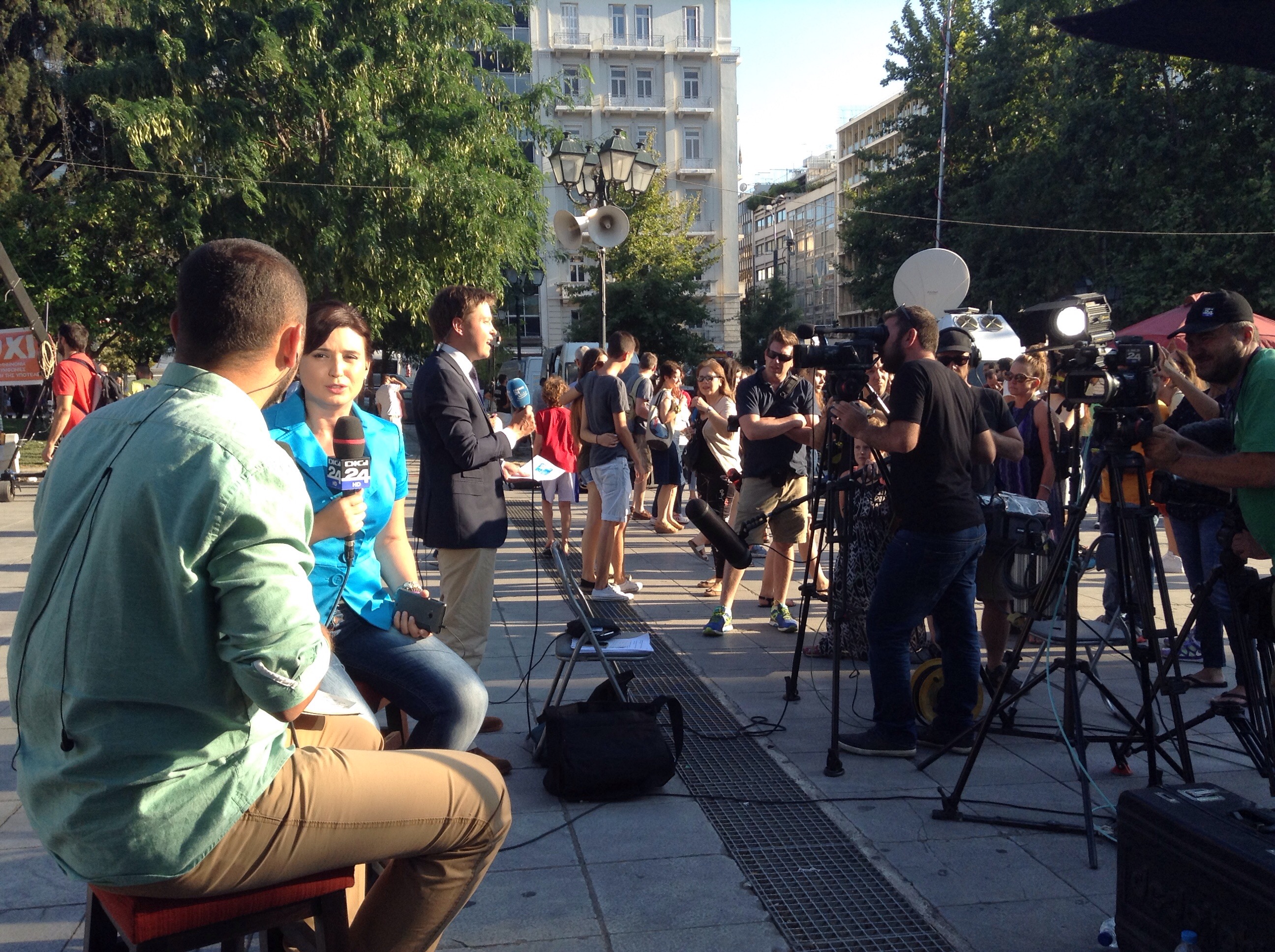
When the best laid plans to travel with a group of theatre lovers go astray, this year I have opted for further exploration of Greek theatre in Athens and Epidavros, combined with some R&R after finishing at Whitley. Today 5 July is a very significant day for Greeks as it is the day the country responds to a referendum to support or refuse the existing offer on an EU economic bail out. After all the hype of television reporting I decided to come to Syntagma to see for myself. So far the biggest crowd is a group of tourists across the road at parliament watching the dancing soldiers. Weather wise, it’s a perfect 30 degrees with a gentle breeze while people take a Sunday afternoon stroll around the square watched by a bevy of local and international television reporters.
  

 It feels like a gentle calm with people heading to the beach and tourists like me sitting under canvas to take tea, ice cream, pizza and greek salad. It’s all very normal I expect and me being extra delighted by the arrival of honey with my tea without asking. Somehow for me there is a sense of democracy in action in the country that created it 2000 years ago, despite the English 20 something’s at the next table talking about the comfort of their shoes. 
My hotel is 2 metro stops away from Syntagma (train tix suspended because banks are closed) in a quiet leafy area so close to the Acropolis I feel I could stretch out and touch it. On the down side the boutique nature of the accommodation leaves little room for me to manouver past my suitcase to even get to the fabulous balcony view.

Tonight I’m heading out to see Pathos Allos theatre do a potted presentation of Greek drama. Fingers crossed that it is on!

Sadly, after negotiating the trolley buses, a good deal of walking and asking for directions, the theatre is securely closed. There is no indication or signage as to why there is no performance this evening and speculation from the locals I engaged with ranges from closure due to the austerities through to closure because it is the day people are voting.

The richness of my exchanges with people are indelibly etched in my travelers’ memory. The trolley bus driver who said he did not speak English. The young corporate lawyer who said that he spoke English and his subsequent enquiry of the bus driver as to where the theatre might be. The bus driver could be regarded as surly or resistant with his clipped or terse responses in Greek as he was delivering a bus load of quietly anxious Greeks to their physical destinations on this auspicious day. After further chatter, the multi-linguistic young lawyer disembarked and following several more starts and stops, the bus drivers turns to me and says ‘next stop.’

Another exchange in a humble ouserie where the stout, middle aged and clearly anxious non English speaking proprietress tried to solve my theatre problem while I sipped an overly large Heineken. Anxiety was palpable in the spotless establishment as two elderly men watched the street passers-by while their ouzo seemed untouched on the table in front of them. The television was turned on for election news. I proffered two five euro notes to pay for the Heineken. The proprietress takes only one and brings me some change which I leave with her. Of course, she could have charged me what she liked and I would be none the wiser. Unlike the young waiter at Syntagma who shortchanged me for my tea. In my mind I had already resolved to tip him one euro for a three euro tea, but rather than challenge him for his miscalculation on this feisty day, I left without issue and without further tipping. So what is the difference? And what makes one taxi driver give a discount because he was unsure of the destination while another blatantly claims the meter charge after a more significant and more blatant driving error? And why do I care sufficiently to write about it letter by letter on the iPad? Is it because these exchanges provide an insight into the character of a nation or simply the character of an individual? And when one is unable to speak the language one loses the nuances that provide the all important clues. 
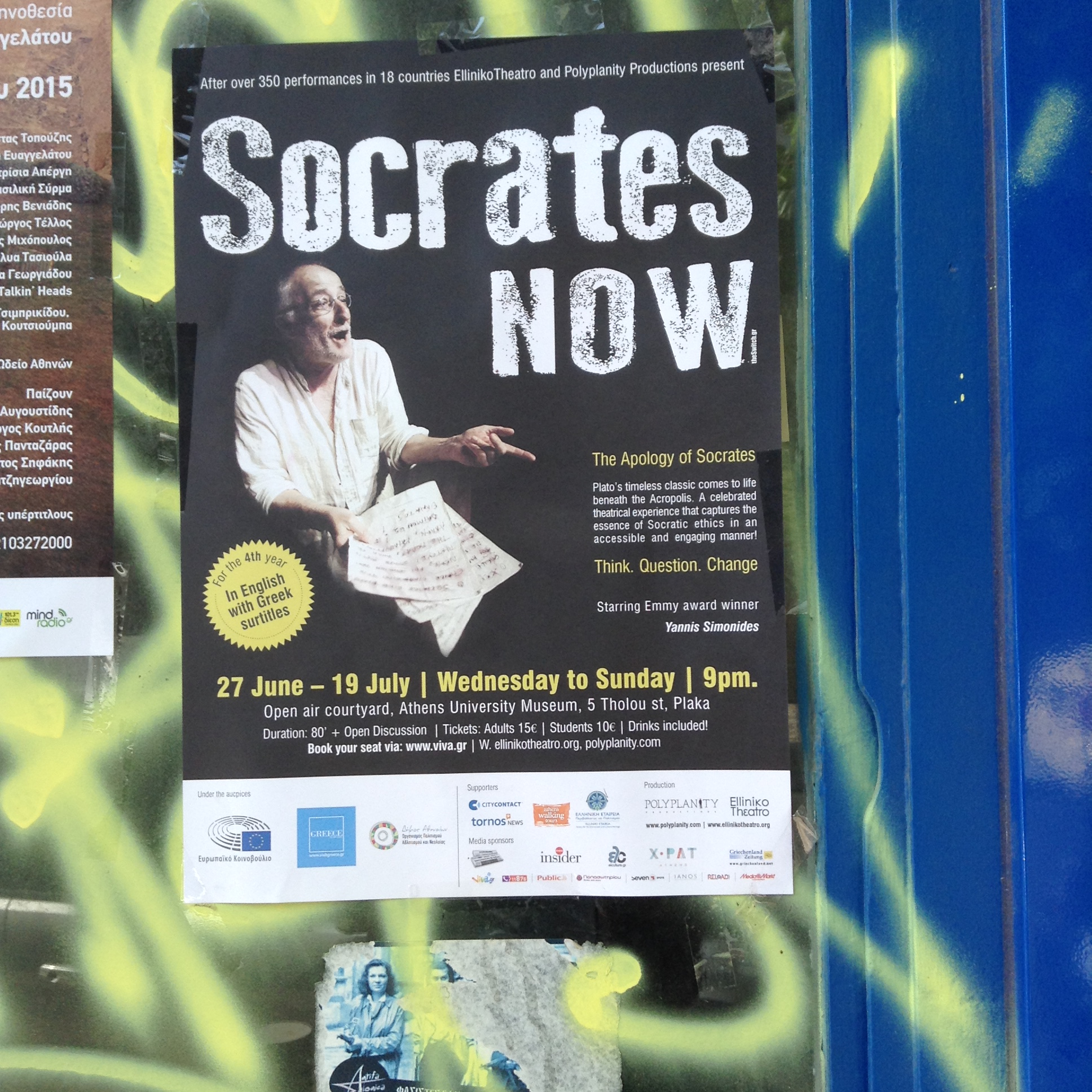
Theatre going has been somewhat less than in other years with my first theatre booking The Trojan Women being aborted due to the late arrival of my plane from Milan. However two subsequent productions have been most satisfying. Socrates Now, is a one man show that I’ve known about for years. It has travelled across the globe, including Australia, and is now in its fourth summer season in Athens. Presented by the eminent Emmy Award winning actor, Yannis Simonides, the production takes place on the Acropolis very near the spot where Socrates was incarcerated. Simonides firstly appears as a mirthful, ungainly and masked Socrates, before unmasking and disrobing to reveal the simplicity of the man presenting his defense to us, the members of the jury. 
A wiry and energetic actor of certain years, Simonides is totally captivating. A trained actor in Classical Greek style with an English delivery resembling the British National Theatre greats, his rendition of the apologia contains all of the humour, pathos, poetry and wisdom that one associates with the great philosopher. In pleading for his life, Simonides’ Socrates claims to have no fear of death despite the obvious separation from his young sons. Repeatedly, Socrates stresses the ethical and examined life over the profane pursuits of money and position. The title of his play, totally contextualises Greece today, and with the topicality of an impending Grexit from the European Project, the notion of Democracy and ethics is never far from the audiences’ consciousness. Nestled in a courtyard auditorium under the great temple to Athena, one is forced to consider what Ancient Greece stands for in July 2015 and how that ancient impulse affected not only the ancient world but the continuing foundations of modern civilization.     
A forum with complimentary wine follows the performance. Simonides reminds his audience that he is merely an interpreter of Socrates as he skillfully invites and manages the subsequent discussion. There is no doubt as to Simonides’ passion, authority and sincerity surrounding the subject matter and his ardent desire to use his art form to promulgate the greatness that was Ancient Greece and its continuing place in the 21 century. Perhaps most fortuitous for foreign theatre goers, is Simonides’ knowledge of Greece’s entrance to the EU with a specific invitation apparently based on its history of the democratic impulse. Furthermore, his ancient and modern knowledge contextualises more than this current issue and clearly demonstrates a strong belief that despite its current challenges the Greek ideal will prevail. 

In my opinion, this performance, presented in English with Greek surtitles, is a must see on the events calendar of any summer traveller to Athens. 

What Makes Good Theatre?


Article Lead - wide6534667512wrg3image.related.articleLeadwide.729x410.12wltf.png1421978791248.jpg-620x349

MIDSUMMA MAGIC AT CHAPEL OFF CHAPEL

During the Midsumma Festival, I had the wonderful fortune of seeing a production that would rate as one of the best pieces of theatre I’ve seen in Australia for years. The production was Loving Repeating presented by Vic Theatre Company featuring Deidre Rubenstein as Gertrude Stein. And while this article is not a review of the now-closed production, the show affected me so profoundly that it made me ask just what is it that makes good theatre?      For the full article go to:

http://www.alltheworldsastagetheatretours.com/makes-good-theatre/

and also check out our July 2015 All The World’s A Stage Theatre Tours GREECE, PORTUGAL & SPAIN or GREECE ONLY.

European Theatre Tours

Interested?  Contact me for Early Bird Discounts. brenda@worldtheatretravel.com

Brenda Addie is the Director of All The World’s A Stage Theatre Tours.

She is an actor, director, producer and writer who knows about theatre.

Find out more about Seeing the World and Seeing World Theatre at http://www.alltheworldsastagetheatretours.com/


10 Great Quotes from Writers about Love

Lovely to know Anton Chekhov is included among writers on love. Happy St V’s Day!

Unknown's avatarInteresting Literature

Ten of the most profound and witty quotes from writers on the subject of love

‘All life is just a progression toward, and then a recession from, one phrase – “I love you.”’ – F. Scott Fitzgerald

‘Self-love seems so often unrequited.’ – Anthony Powell

‘You cannot save people, you can only love them.’ – Anaïs Nin

Quotes about Love‘The Bible tells us to love our neighbours, and also to love our enemies; probably because they are generally the same people.’ – G. K. Chesterton

‘Love and scandal are the best sweeteners of tea.’ – Henry Fielding

‘Of course it’s possible to love a human being – if you don’t know them too well.’ – Charles Bukowski

‘To be fond of dancing was a certain step towards falling in love.’ – Jane Austen

‘There are all kinds of love in the world, but never the same love twice.’ – F. Scott Fitzgerald

View original post 56 more words

10 Free Online Resources to Improve Your Writing

InterestingLiterature's avatarInteresting Literature

In this guest blog post, Sharon Crosby shares 10 great websites that can help you improve your writing skills

It often seems that there are not enough online resources for writers. There are many good books on the subject, but they cost a lot of money because the writing community is a relatively small niche. Here are 10 resources you can use whether you are a professional writer or a young content manager to improve your writing, to make your content more interesting or to get published. All the websites have something different to offer writers.

  1. Writer’s Digest

Get your hands on lots of writing and research advice. The homepage is a little too crammed with links for most people’s liking, but once you get used to how the website works you can find plenty of tips and lots of pieces of advice on writing. The great thing is that…

View original post 818 more words

Day 19 Barcelona and Ubu Roi


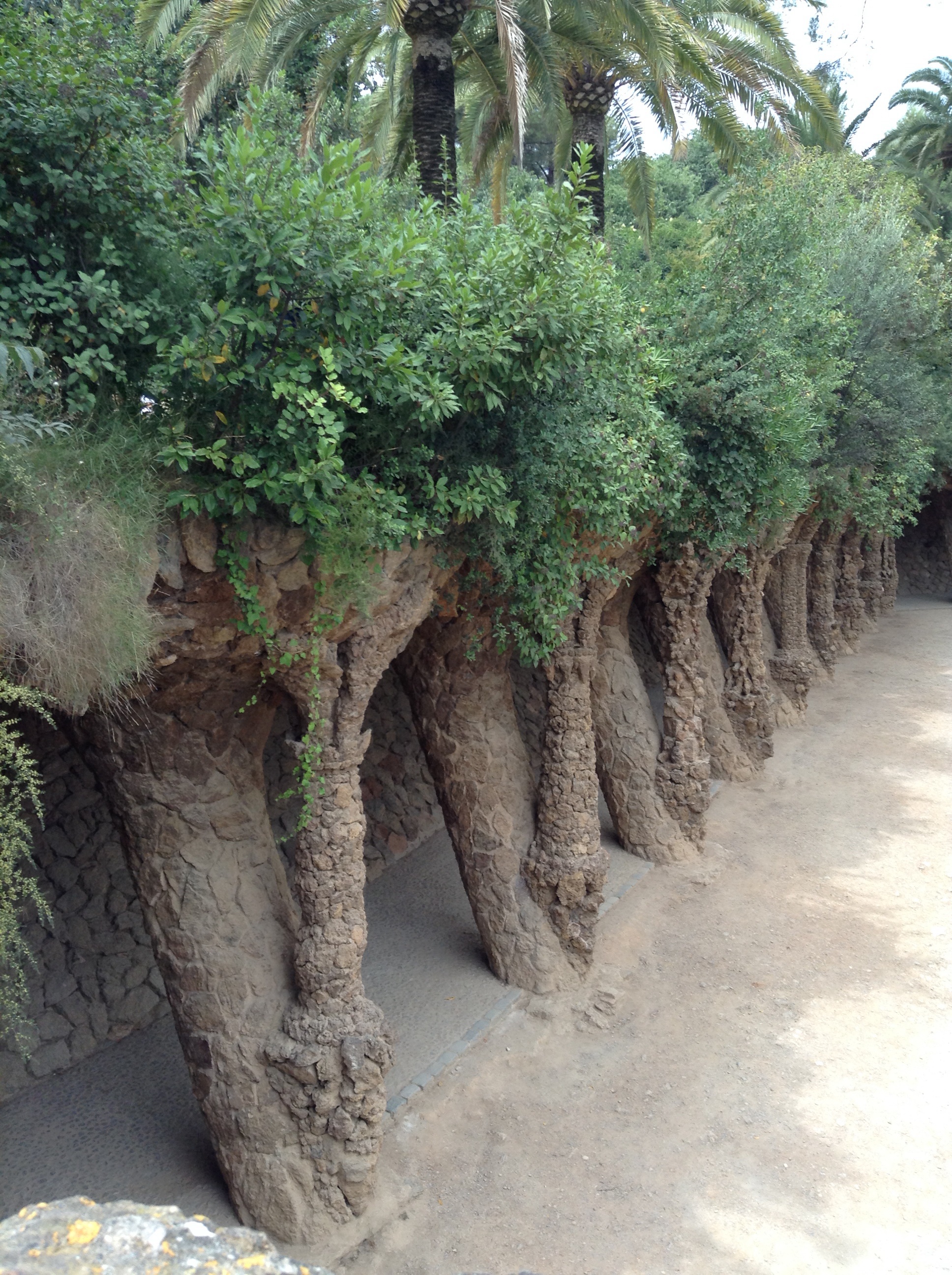
imageMy final day was spent at Parc Guell and with this visit all my long held desires to explore Gaudi were realized. Again whimsy and practicality are forged with nature and this beautiful location captures the cool harbor breeze that eludes the town below.  Gaudi, greatly informed by the ancient Greeks, has made our world a more beautiful and happier place.

image

image

image

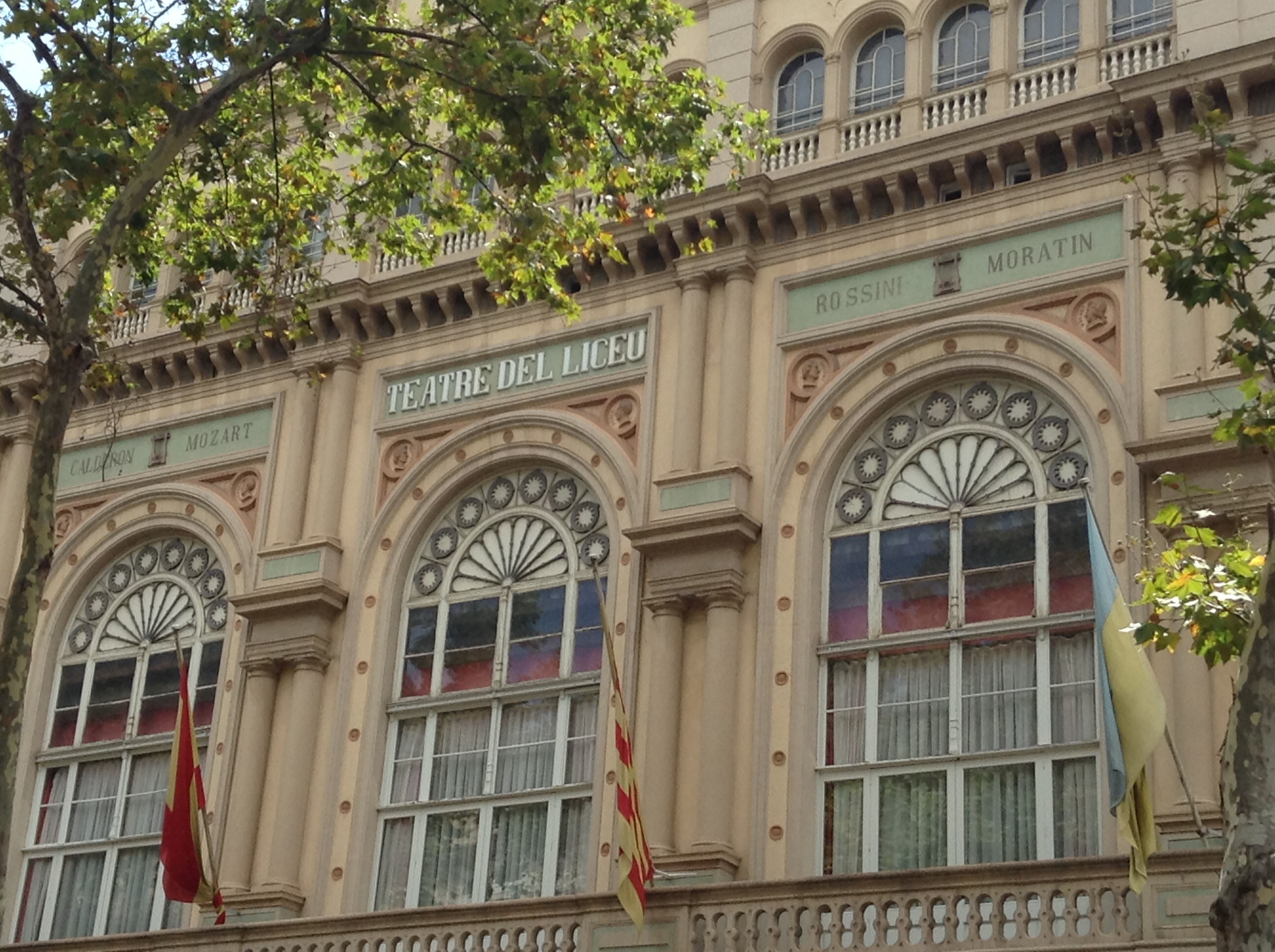
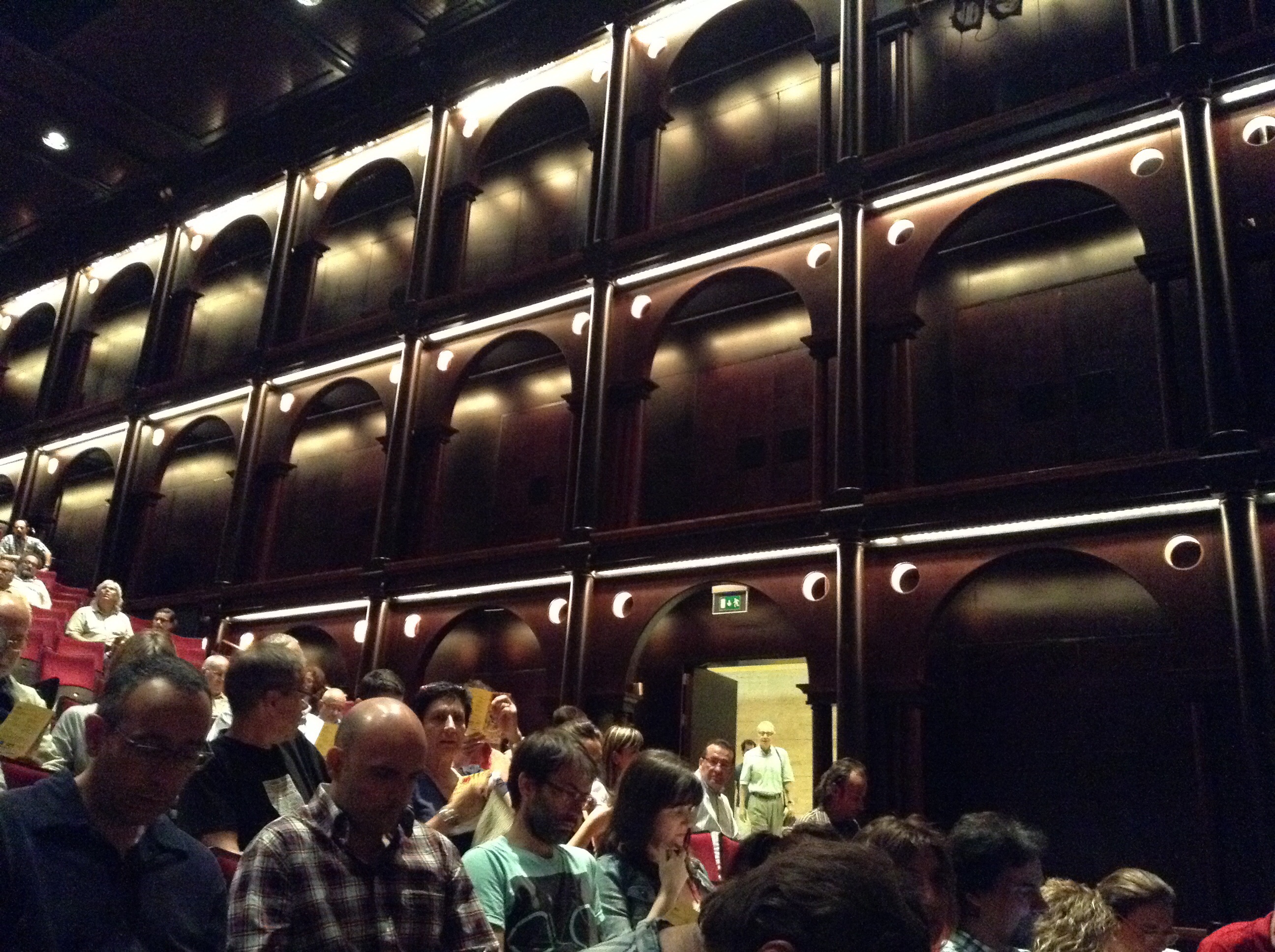
With a few hours to go before going to the theatre, I decided I really should try to do some shopping and so I started along the Ramblas only to find the last thing on my bucket list, the Gran Teatro Liceu and I was able to join the final tour of the day.image

It really is a superb opera house in the Italian style. Privately owned for generations, it is now in the hands of the government. Its most recent refurbishment following a fire in the 1990s, has improved the acoustics, the staging, rehearsal and dressing rooms and made the previously exclusive grand reception area available for all patrons. It’s a lavish and very appealing theatre.

image

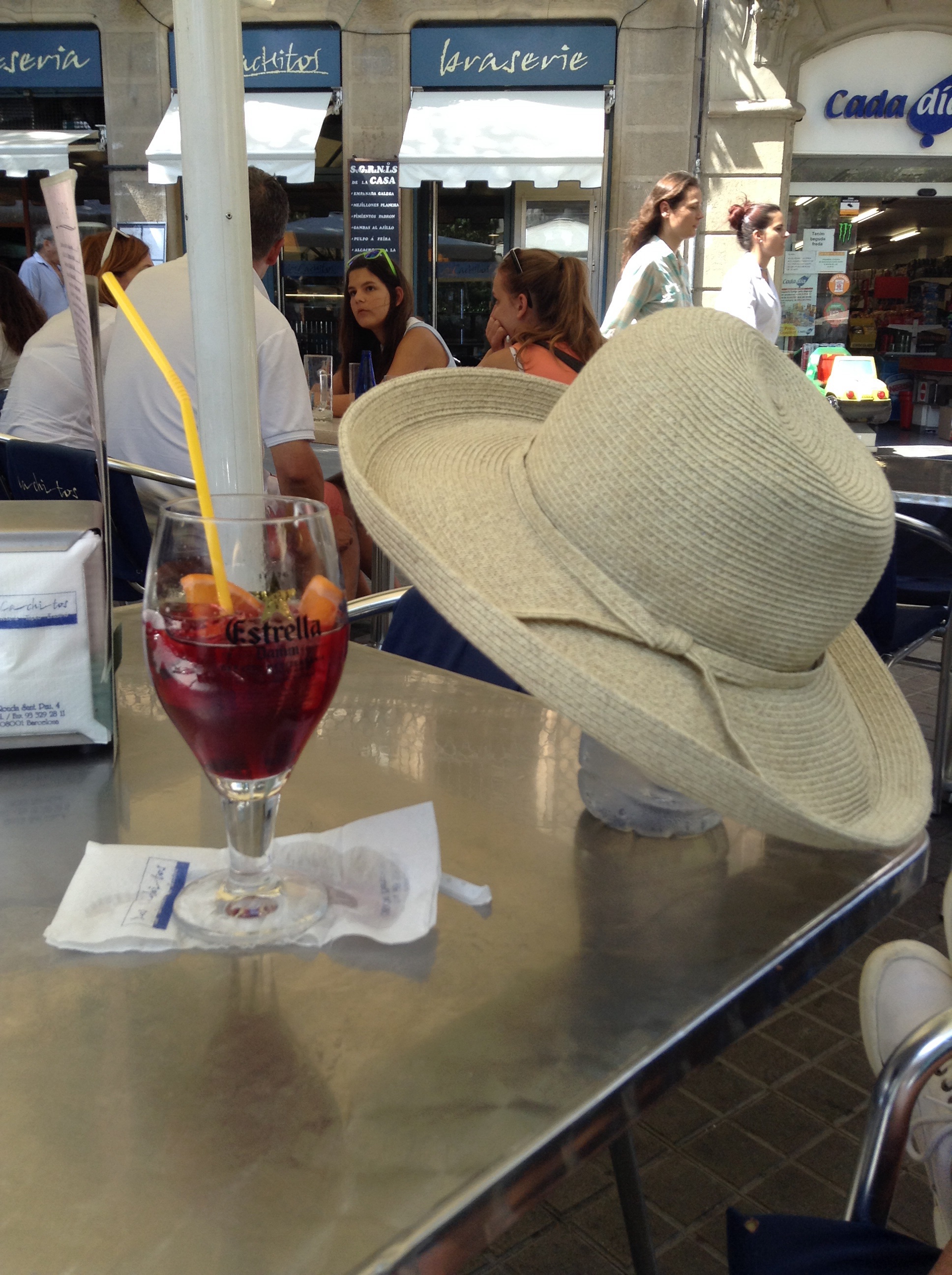
And finally after a sangria and a sit down it was time to find the Teatre Lluire on Mont Juic. I never did get to do any shopping. image

As I walked amongst the charming buildings of this arts precinct to get to the theatre, I discovered the Barcelona Institute of Theatre, an establishment that has always fascinated me in that it has a specific charter to teach, research, conserve, promote and innovate Catalan performing arts. It has also hosted many significant, international theatre studies conferences.image

imageNot knowing what sort of theatre is housing Ubu Roi, I’m astonished to find myself in the 1929 Palace of Agriculture, also built for the World Fair, now with a 2000 seater conversion in high Barcelona design. Even more astonishing is that I’m in the front row.image

And the play is also astonishing. With a fine pedigree coming from an invitation from Peter Brook, Cheek by Jowl created this production in co production with The Barbican, London.

Presented in French with Catalan surtitles, this is French high art in what I would expect from  La Comedie-Francaise. Jarry’s, Ubu Roi (1896) is always open to extraordinary interpretations and while this was salon style farce in a proscenium arch theatre, it was not so much the interpretation that was astonishing but the performances  particularly of Mere and Pere Ubu. However can I describe their energy and ability to turn on a sixpence? However can I even imagine what the rehearsal process must have been like to accomplish this level of slickness and how did the director know/ imagine what these people were capable of? How did he take them to those places? What an extraordinary accomplishment.

And please remember that I’m seeing this in a language I only just understand, so for the most part I’m missing the text and seeing French chic dissolve into the madness of vulgarity and scatology and back again. Really, for acting and production, this show takes the prize on this trip. Cheek by Jowl has presented a wonderful range of classics and this is no exception. I think there were at least 20 curtain calls. The audience went wild for it and so did I.image

What a wonderful note on which to end this tour.My sincere thanks for all comments, tweets and follows. It’s been a joy to stay in touch.

The next tour? Same time, same station, 2015.

Please go to http://www.alltheworldsastagetheatretours.com for a full itinerary and to register your interest to See the World & See World Theatre. It’s a great experience.

In theater, there is nothing to understand, but to feel.
Louis Jouvert
French actor and director.

Barcelona and the Teatro Grec


image
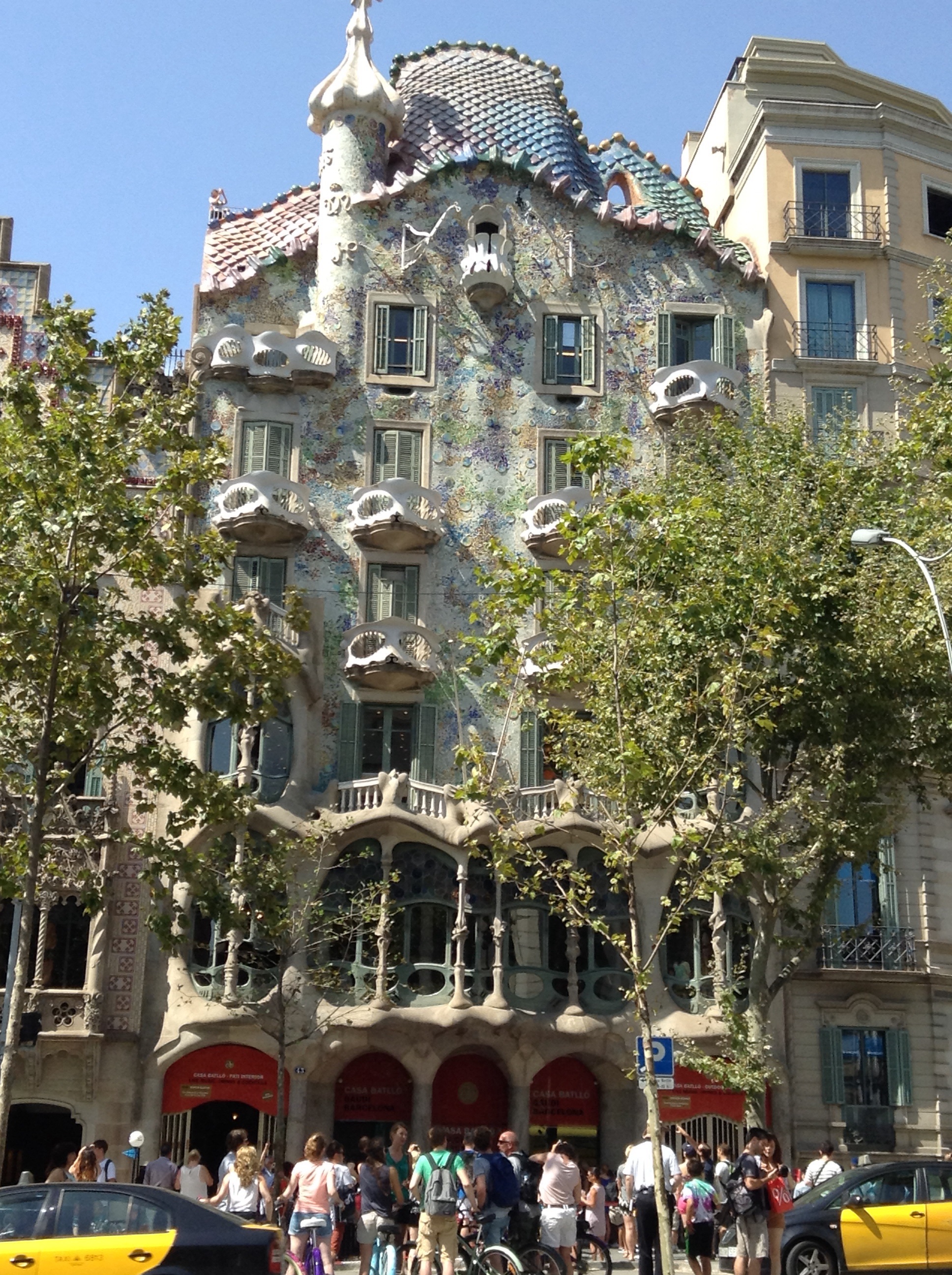
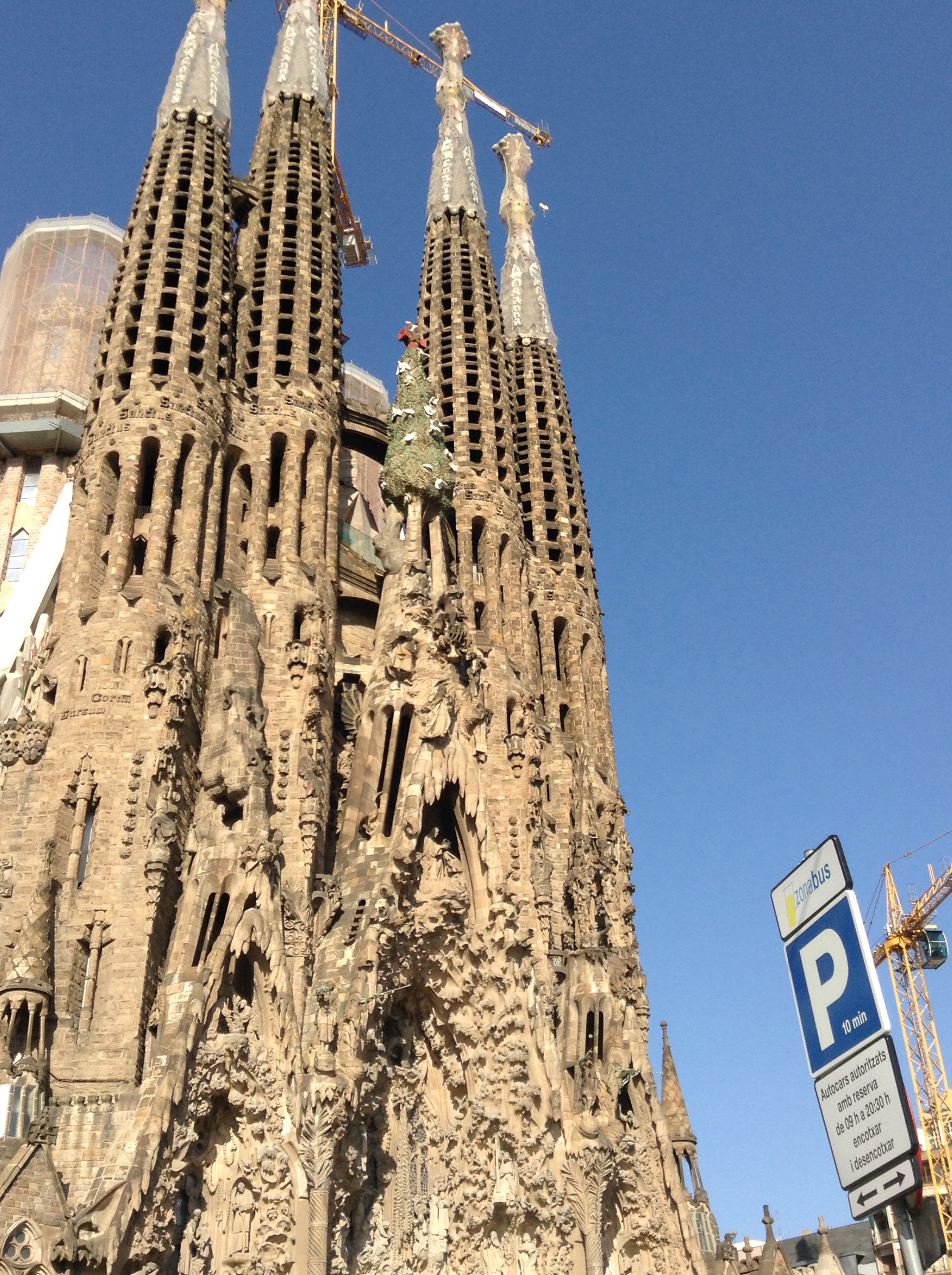
 This started out as my dedicated Gaudi day and on arriving La Sagrada Familia, I found that not only do I need to buy a ticket, it was allocated a time when I would be admitted. Ok so what to do for two hours? So using my metro ticket I headed off to find Gaudi’s  Casa Batllo, the Rambles and the Boqueria, all of which I had spotted from the taxi last  night.  The whimsy, charm and architectural uniqueness of Gaudi is astonishing and on the Casa Battlio, I discovered that the balconies are cat faces!  image

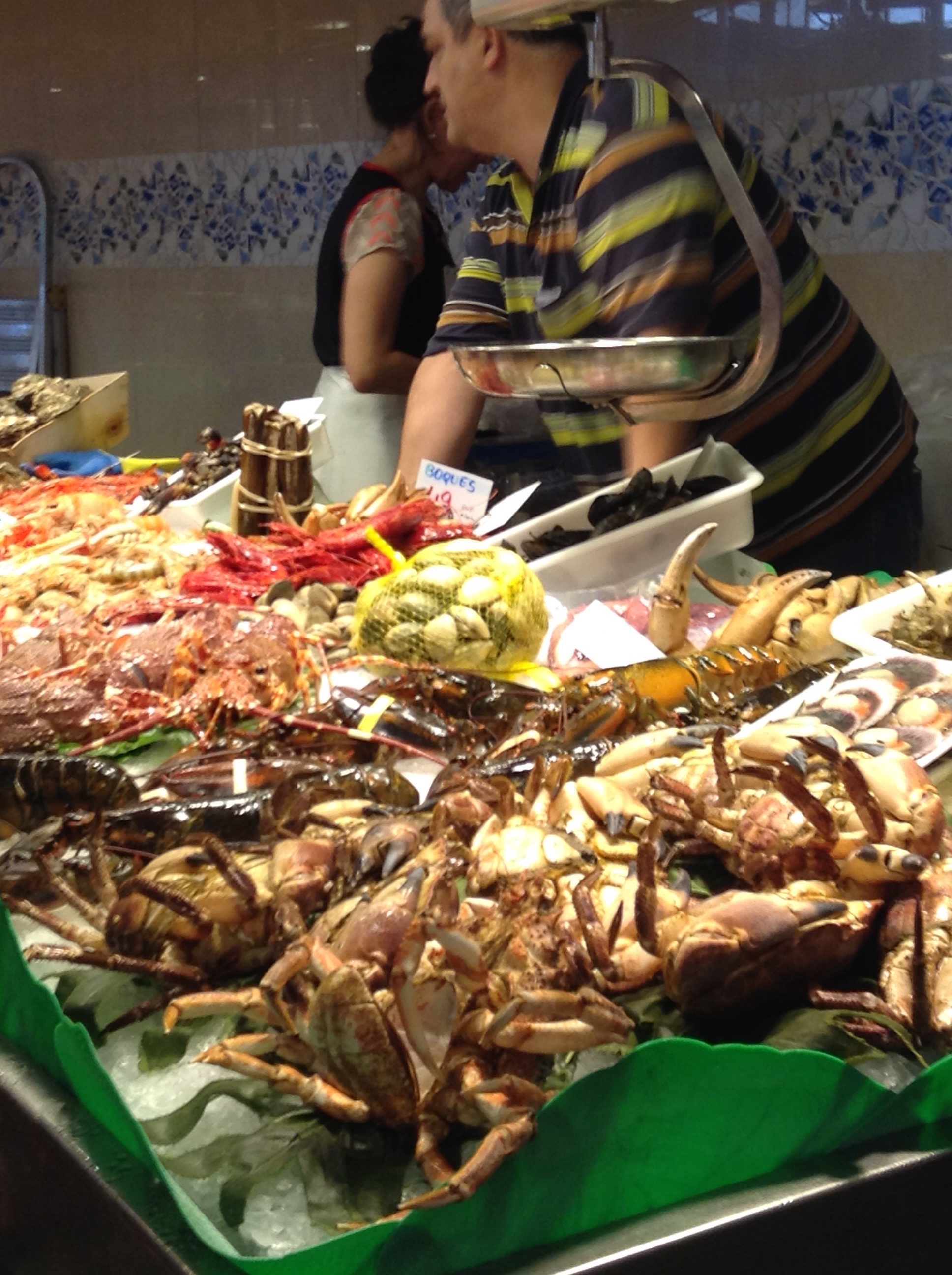
The Boqueria on the other hand is all bustling business and practicality, but once more the displays have that intrinsic Barcelona aesthetic. I’ve never seen so much food, especially the fish and to think this is replenished every day. It is a ‘feast’ for the eye and a well deserved tourist attraction.

image

image

It would be interesting to know just how much Gaudi and tourism contribute to this ailing economy – the cost of the continuing construction of the cathedral must be enormous. And while there, you are very aware that the stonemasons are at work.

image

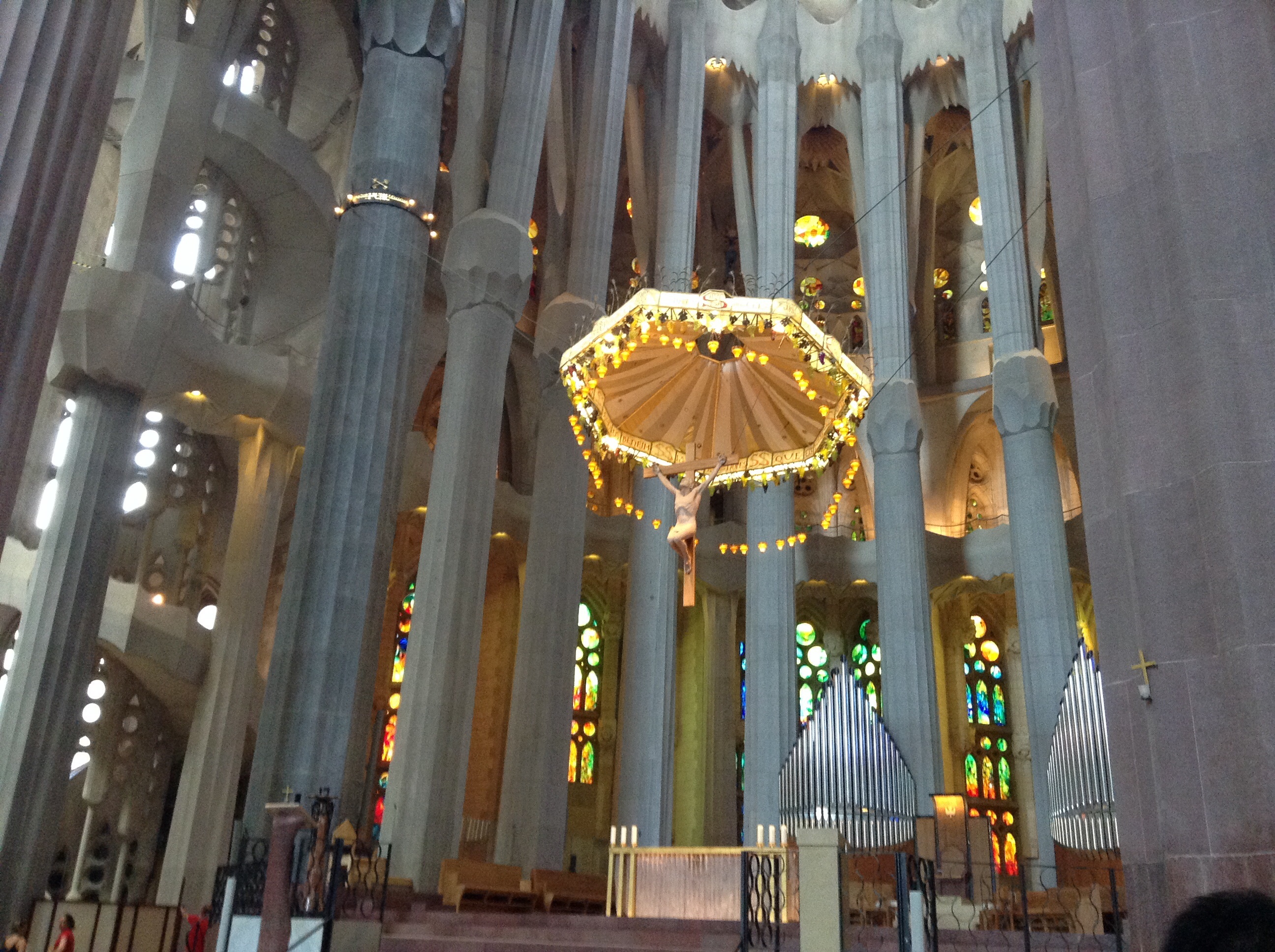
Once inside the cathedral, the beauty just overtakes you and Gaudi’s use of colour and form found in nature, in contrast to the richness and heaviness of gothic cathedrals, makes this one feel like a breath of fresh air. It is truly enlivening.

I have just arrived at The Teatro Grec having left Ted and Jo in the most amazing gin joint I’ve ever experienced. My gin was enhanced with grapefruit and ginger and it too was heaven in a glass.

imageAnd then into my third heaven for the day, seeing the beauty of this place after the heat and bus-i-ness of down town Barcelona. It has been a very hot day with traces of rain and just being in this elevated location on Mont Juic has relieved the oppression of the heat, or was it Victor’s Gin Palace?

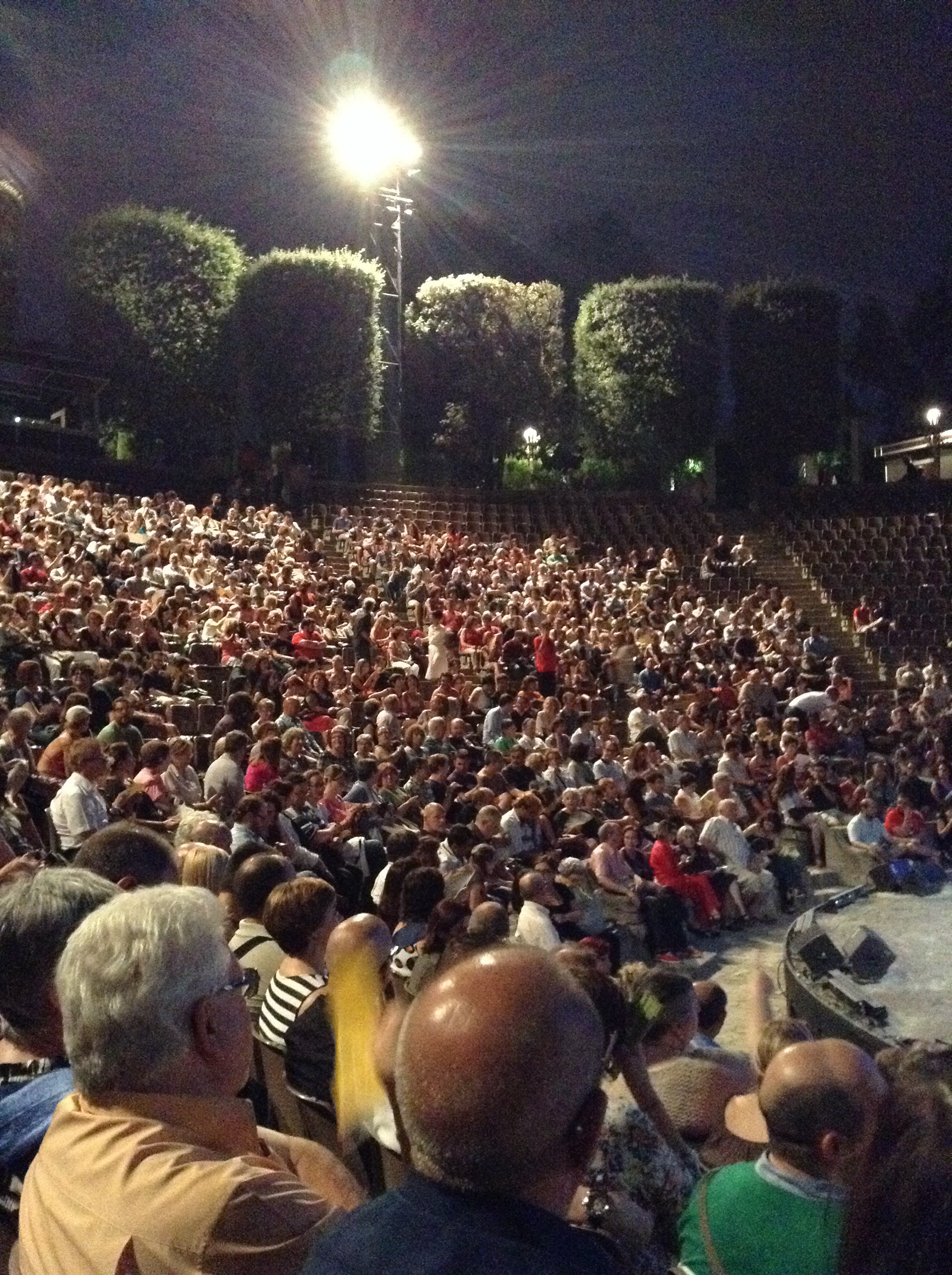
imageHaving said that it’s 10 pm and the production is about to begin without any further threat of rain. However it had been sufficiently disquieting for me to put a hooded jacket in my bag – does it ever rain on Spain’s outdoor shows? I’m well used to people bringing fans and fanning away, but do they bring umbrellas? And of course people do stand in the rain at The Globe Theatre and the actors also get wet…

image

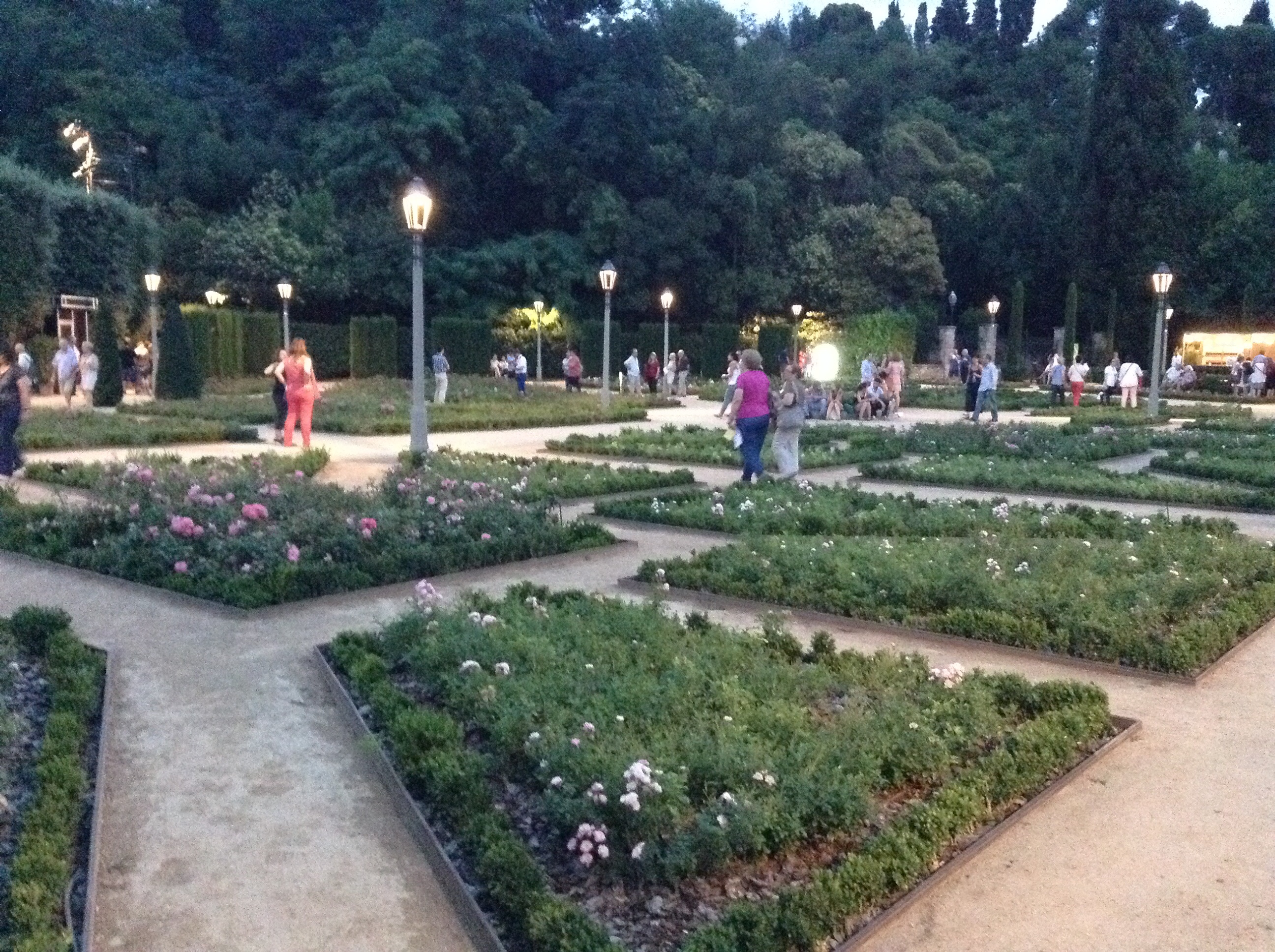
imageThis beautiful ampitheatre, man- made for the 1929 World Fair, was created from a disused quarry and the whole place has a beautifully peaceful Greek aesthetic, including a lovely  garden and restaurant. The architect, Ramon Reventos, was clearly a neo Hellenist. I suspect the auditorium holds some 2000 people and tonight it seems almost full.

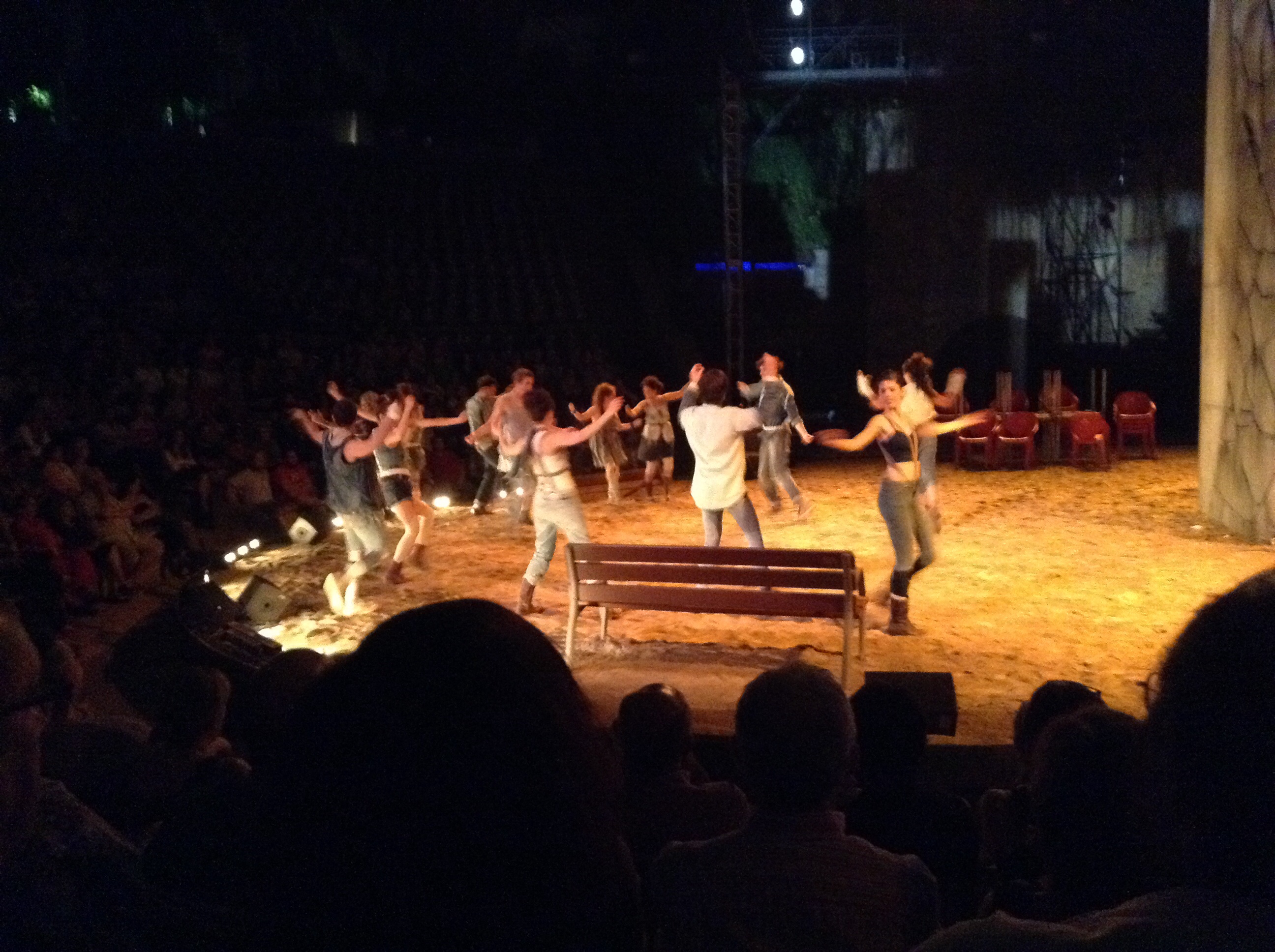
I’m in a little trepidation as to this production,  Batolome Encadenado, as it represents a modern version of Prometheus, billed as a tragi comedy with a chorus of actors from the Theatre Institute. Each year a writer is asked to create a text around contemporary themes in relation to  Greek theatre. With social and political overtones, this does address the economic situation as the premise for the story which deals with the theft of lower and middle class workers money by the World Bank.

imageAnd whilst the cast of young activists were enthusiastic and commited to the piece,  for me the production was enhanced by a light and sound show type of projections against the back wall of the theater. This worked really well and gave a texture to the otherwise one thing after another predictable nationalistic ardor. I will explore the genesis of this work so as not to disgrace myself as to its significance.

The audience was appreciative and all of sudden they dispersed down the hill. How will I get home I asked the hotel porter. Follow the crowd! I did just that and ultimately found myself in Avenue Parel-lel within a good stroll of the hotel.

image

So a great day. Gaudi, The Teatro Grec, the Bocheria, Victor’s gin palace and catching up with Ted who I haven’t seen since May. He and Jo had fulfilled one of their Barcelona must do’s spending the whole day on the beach.

Barcelona


Day 17 BARCELONA AND THE GREC FESTIVAL

imageArriving late in the evening from Madrid, in the morning it was great to find how conveniently my hotel is situated among the arts centre of Montjuic and many of the cultural sites of the city. All within easy striking distance once I got my Metro ticket and my bearings. With several objectives to round out my previous Barcelona experience, this visit was planned around the festival, followed by sightseeing of the National Theatre of Catelonia,  Gaudi, the Gran Teatro Liceu, the L’Auditori and then some. image

The festival is so named after the Teatro Grec, an ampitheatre also located on Montjuic and while it specializes in contemporary theatre, its international reputation made it a must see for me.

The exciting thing about Barcelona, is that you can turn a corner and there is some significant monument or building that you’d read about or always wanted to see.

Simageo for me, on day one, it turned out to be the Bullring and the Bullring Museum. Why wouldn’t one important cultural activity be in the same area as the others? And I stumbled across the bullring on my way to find the NTC. image
Both were equally impressive. I found the theatre workshops before I found the theatre and then discovered that the whole thing takes up a block in the area devoted to culture. It is huge! Also en route I found the Auditori for music events   – again huge, with a terrific horse, a restaurant where the arts crowd eat, and where I had my first Barcelona speciality, fideula, and the Barcelona design district, enfant,bn.

The spires of  Sagrada Familia are  very present on the landscape so I jumped on the metro to make a recce and after seeing the queue for admission decided that this would require a dedicated, early morning excursion to actually get into the basilica in under an hour or three.

image

So that was day one, rounded off by a production of Pinter’s Old Times at the Sala Beckett in a very elegant part of town. image
How to get there? Two metro changes and a walk…I didn’t think so and so more I added to my ownership of Barcelona taxis.

image The Sala is cute, very cute, but the playing area is very challenging and so was Pinter for the Spanish cast. Working  on a raised stage, running the width of the room, our eyeline was at crotch level with the three actors and their closeness to the ceiling was very disconcerting.image

I love Pinter and I think that playing this one on the floor with the audience raised around the actors, might have been an improvement. In other words we all  would have been in their space retracing our old times.
The Sala Beckett is dedicated to experimental theatre. It provides space and courses for young writers,  and specifically promotes contemporary drama, and it was certainly worth the effort of two taxis.


image imageimageimage