This has been a thrilling journey and has delivered more in the way of cultural richness than I ever imagined. Quite apart from the truly wonderful theatrical experiences, it has been the sense of place that has so anchored everything I have seen. Medea at Epidaurus in Greece is a stand out as are the Irina Brook Island Trilogy and Bob Wilson’s The Old Woman in Spoleto. Irina Brook couldn’t believe it when I told her I’d come from Australia to see her work.
And then there was Almagro which was a significantly different cultural aesthetic from Spoleto, offering gorgeous Golden Age plays with the distinct advantage of meeting Vincente Fuentes who ‘just loves language.’ I too have discovered a penchant for language and whether that be English, Greek, Italian or Spanish or French etc, so much is to be gleaned from the original language text which imbeds the societal and historical context of place.
Of course in many instances the language is high or old, or Baroque, as is the case with the Spanish Golden Age, which offers yet another layer to the exploration, and why Vincente Fuentes is such an expert in the field. It’s much the same as our specialist Shakespeare coaches.
While theatre has been the driving force behind this trip, you will have gleaned that it has gone hand in glove with other cultural aspects of place – food, history, religious practices, dance, music, art, amazing landscape and of course, shopping.
Thank you for sharing this journey with me, I’ve been grateful for your company and I really loved getting your comments. Next year I’m planning to offer a similar tour through All The World’s A Stage Theatre Tours. Perhaps you may care to really join me?
Thank you, too, to Pan Australian Travel who put the itinerary together so marvellously and for choosing such comfortable, diverse, enjoyable, and well located accommodation.
In the meantime, I’m going to work on my languages and continue to explore the international canon of world theatre.
Please feel free to contact me re tours at brendaaddie@gmail.com.
Sincerely yours, Brenda.
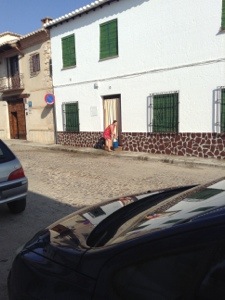
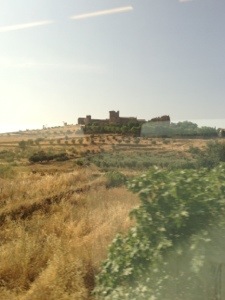
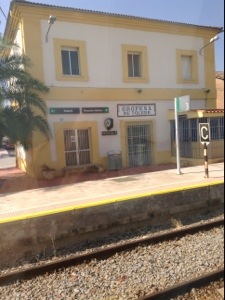
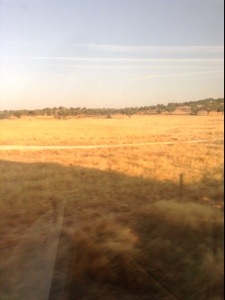
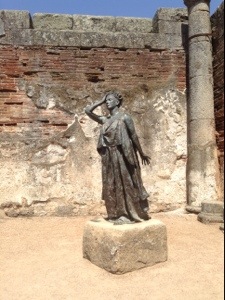
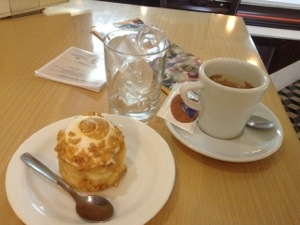
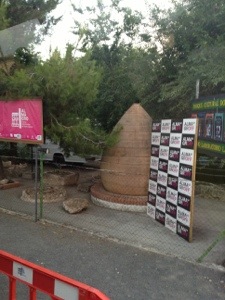
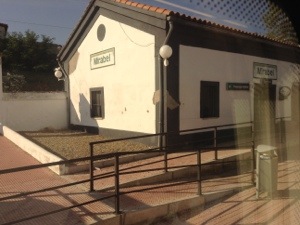
P.S. I’ve just added some random shots that I didn’t have space for on the blog. I particularly like the landscapes, stations (some of which are taken from the train) and other oddities. The cup of coffee and glass of ice is an example of lost in translation for iced coffee:)
Merida Roman Ampitheatre, Apelius’ The Golden Ass, Colosseum, Roman ruins and cultural influences.
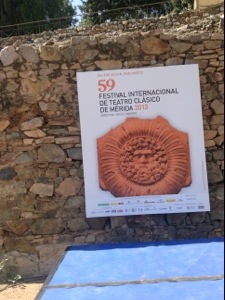
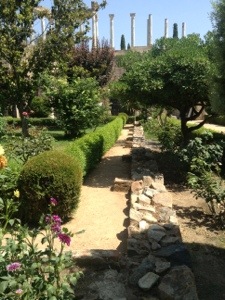
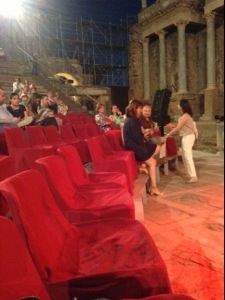
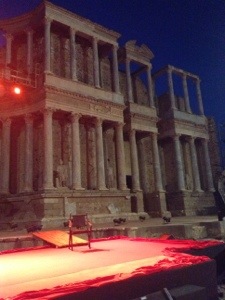
I’m sitting in the front row of the orchestra at the Merida Roman Theatre. I’ve got best seat in the house and I’ve also got a beer. It’s 10.45 pm, the play is about to begin, and it’s still 34 degrees. The play is Apelius’ The Golden Ass and I’m very excited. This is my last show on this tour, and as I look up at the columns and at the theatre architecture, I am over-awed at the importance that was placed on performance. Maybe the play wasn’t as significant a spectacle as the gladiatorial sports in the Colosseum adjacent to this site, but at the back of the theatre is an area referred to as the Aula Sacra. It is a very beautiful space with a garden, an altar, and a (dry) water race that indicates the importance of the theatre as a dedication to Augustus. Merida, was originally known as Augusta Emerita. Of course in this theatre, the actor is humbled in the size of the space – 5000 people in the audience, and statues of gods, goddesses and important Romans, including Ceres/and Livia, Augustus’ wife, standing behind and above you. People on the stage certainly appear ant like in this space and it’s not about performance, but the glorification of the Emperor and Rome.
This theatre provides the most excellent example of the continuation of performance from Greek to Roman theatre in amphitheater style. However, it is the Roman architectural improvements to the Greek amphitheater that provided the greatest development in theatre history. With the ability to build beautiful continuous arches, the Romans introduced a free standing auditorium rather than one fashioned out of the slope of a hillside that gave way to the concept of the proscenium arch. The columnar scenae frons has 3 main archways by which actors made exits and entrances and in order to reinforce the notion of Roman hierarchy, access to the controlled seating was made via the archways adjacent to the stage area. Thus the influence of the Romans in theatre architecture is not only considerable but it has proven to be of lasting significance in that it has continued to this day. Perhaps it could be said that the Greeks perfected acoustics, and the Romans developed free standing theatre architecture with a proper stage and the ability to add a roof.
From a textual point of view, the Romans emulated Hellenic values in aesthetics and cultural content and enjoyed performances of Greek texts as well as works by Roman playwrights such as Seneca, Terrence, Plautus and the comedies of Livius Andronicus.
As I said earlier this theatre seats 5000 people and tonight it is full. This makes me wonder how important theatre is in this part of the world. And remember, people are coming out at 22.45 to see a show – a distinctive cultural variation from colder climate 8 pm starts.
Merida has such a pronounced pre Christian Roman culture ( it was founded in 25 BC) that it is not difficult to detect the connections between the Greek and Roman Empires. However, one significant difference is that the Roman Empire was all about the Caesar and war heroes. Augustus gave this town to returned/veteran soldiers, hence Augusta Emeritus, to build a bridge over the Guardiana and to protect the pass. The river is huge and clearly the surrounding area is noticeably fertile. As well as seeing orchards of peaches, plums and apricots, plus grapevines, maize/ corn and olives, I also saw the olive presses, preserving factories and even several commercial plant nurseries with date palms, poplars and crepe myrtle.
During my 3 hour drive from the plains of La Mancha I saw several municipal bull rings, one of which, in the middle of nowhere, was actually square and is quite famous. I’m still quite committed to see a bull fight. The plains eventually gave way to rugged mountains and after the mountains came soft pine forests and there were road signs indicating the presence of deer. As I had made a commitment to not deviate from the main road, which incidentally, was signposted Badajoz, Merida and Portugal, (I was driving in a due westerly straight line) sadly I missed the cute agricultural villages which I have been told have their own particular architecture and cultural charm. Next time.
On arriving in Merida, I decided to fill the hire car with petrol and when I pulled up at the petrol station, I was assaulted by the sound of piped and very loud Country and Western music – not even in Spanish! What a shock after the environmental peace of Almagro.
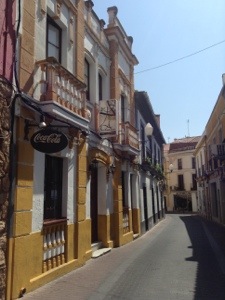
My accommodation, the Merida Parador is a made-over Convent. It is very elegant and very cool in the heat of the day. Merida itself is a walking town and I was so glad to give Avis back their car and to explore the town on foot.
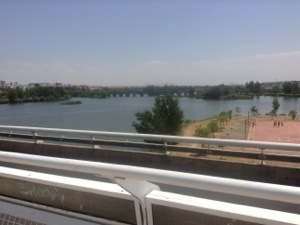
Roman architectural ruins are everywhere and I first encountered the Roman Bridge when walking back from Avis. It is extraordinarily long as the Guardiana River is incredibly wide. I read somewhere that a flood had washed some of the bridge away and the Romans simply rebuilt and extended the bridge span by adding more arches. The contemporary bridge of a single span construction is a little upstream and is a 4 car causeway with a central and very wide bike and pedestrian section complete with park benches for resting and viewing the beautiful river. No wonder the Romans came here.
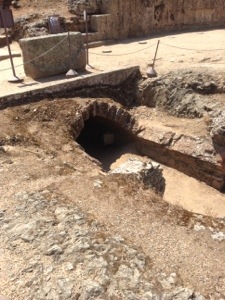
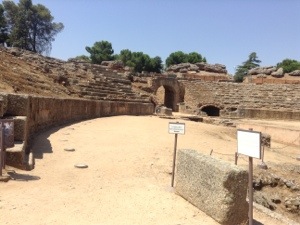
Before coming to this performance, I was ‘ a mad dog and English men’ type of tourist braving the heat to examine not only the Colosseum and the Ampitheatre but also the Temple of Diana. I trust that the photos will provide a sense of the wonder of this place. First of all in contrast to the theatre, the colosseum accommodated 20,000 people. The Roman sense of spectacle is something I believe still exists today and I have a sense that it is a traditional offering provided for the masses. In some ways I think the bullfight is an extension of gladiatorial sports but at this stage I have no hard evidence of that, except that bullfights were also put on to entertain nobles and visitors.
This evening’s show, The Golden Ass, turns out to be a huge GP performance and remember the place is full! I appreciate that a Director of a Classical Festival needs to provide something for all comers and just as the television stars had filled the space in Almagro, the star of this show is Raphael Alvarez known as El Buro…and the audience loves him.
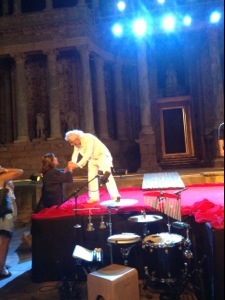
He appears to be around 60 years of age and has skillfully adapted Aupelius’ huge work of magical longings, sexual intrigue, murder, incarceration and ultimate liberation. A one-man, three piece band, raconteur tour de force. It seems he might have localized some of the content, but after his opening gambit, delivered in amongst the audience and reminiscent of a live TV host, he held the audience in the palm of his hand.
Rafael Alvarez, who is a very well respected and renowned theatre, film and tv actor looked incredibly small in the huge space but he certainly delivered a huge show. He started at 10:45 and finished at 1:45 with a 15 minute interval. With tickets ranging from €13.0 to €39.00, I think you’ll agree, it was pretty good Box Office, and Spain needs all the help it can get just now.
A newspaper interview with ‘El Brujo’ gives an incite into his experience of being involved in the Merida Festival. Rafael Alvarez ‘El Brujo’ ACTOR Y DIRECTOR. ESTRENA ‘EL … http://www.elperiodicoextremadura.com/…/rafael-alvarez-el-… – Translate this page
As I look back at the photos of Merida and the Roman theatre, it has to be up there in terms of experiences and proves once more the value of seeing world theatre in situ.
Almagro International Festival of Classical Theatre, Almagroff, Golden Age of Spanish Theatre, Fuenteoveojuna by Lopes de Vega, El lindo don Diego by Moreto, Fuentovejuna by Lopes de Vega, the Castile – La Mancha countryside, Almodovar’s village, Caldaza de Calatrava, Volver
This was a wonderful day and almost as if I’d be saving the best till last. In preparation for my drive to Merida tomorrow, I had to go back to Ciudad Real to collect the hire car before 1.30. Once again I headed to the Almagro Estacion and made the 15 minute trip by fast train. As I needed to familiarize myself with right hand side of the road driving, I decided to do a bit of sight seeing before returning to Almagro. I started off in the heat of the day and as I was driving (well getting lost really) around Ciudad Real, I saw a very big market. And the best thing was that it had stall after stall of fruit and vegetables! I left with bags full of goodies.
From the market I went to several special sites including Alacros, a medieval town, military stronghold, which included the Knights Templar Order of Calatrava, and a battlefield, against the Moors. Close by is another historical medieval sacred castle and monastery called Calatrava La Nueva which the Knights of the Calatrava maintained.
Just exploring these places enabled me to contextualise the period of chivalry in this province of Castile-La Mancha that so inspired Cervantes. Looking at the broad, empty landscape (and not a windmill in sight) one can appreciate the journeys of Don Quixote (with his squire, Sancho Panza) and his quest to do right.
Another curiosity is that Calzada de Calatrava, the village at the foot of the castle, is the birthplace of Pedro Almodovar. When he was 8, Almodovar was sent to boarding school in Caceres, Extremadura, which is in the Merida area of Spain. His film,Volver, is based in and around Almagro and I was reminded of the opening scene when each day I noticed the women in Almagro scrubbing the brick work, window sills and pavements of their houses. Of course Almodovar is exceedingly famous now and he lives, and has his production office, in Madrid, but it is interesting to connect any artist to place.
While I was in Caldaza, I stopped in a bar for an ice cream, and there I saw a local Bullfight on TV. I am greatly attracted by the theatricality of Bullfighting and have resolved to go to one. Madrid of course houses the main bullring but as it is a seasonal activity I will need to plan for it on another trip. Although, I’m not averse to a municipal bullfight like the one I saw advertised in Ciudad Real.
Before going to the theatre in the evening, I was able to include a visit to the Museum of Theatre. What I found extraordinary is that the museum is a huge building at the end of the Plaza de Mayor
in a small provincial town. While it may be true that Almagro values the tourist influx associated with its’ festival, I also suggest it is equally true that it also has the greatest respect for its theatre history and the history of theatre in general. This museum focused on theatre memorabilia, ephemera and costumes. And sadly for me, its’ opening at 6 pm meant that I had very little time there before going to catch the bus to Teatro La Valete. This museum is another place to which I’d like to return.
This production Lopes de Vega’s, Fuenteovejuna, was a perfect blending of old text and contemporary adaptation. I am told that it has been in the company’s repertoire for some two years, and that certainly shows in terms of slickness, wonderful ensemble work and a real commitment to telling the story.
Set out of doors on this beautifully balmy evening, the play unfolded with all of the well known elements associated with this piece. Despotism, municipal corruption and abuse of power, community fear, torture on the rack, the ultimate resistance by the community and hubris of the Corregidor was handled in the manner of modern day activism, sort of a class action approach, with appropriate slogans, chanting, a petition and enlistment of supporters, to no avail but a totally concerted agreement by the whole town that ‘Fuenteovejuna made me do it.’
Each actor excelled in representing the various characters and situations as well as working well with the audience to gain its support for the cause. It’s a marvellous play, which I encourage people to read. And at the end of it, I couldn’t help but feel it was an appropriate choice given Spain’s economic difficulties at the moment.
The second play of the evening was totally superb. El lindo don Diego by Agustin Moreto, was for me an example of everything The Spanish Golden Age of theatre stood for. Performed by Compania Nacional de Teatro Clasico, it was a triumph of style, theatricality, wondrous period costuming, innovative, economical, stage design and beautiful execution of the verse on the part of the actors. (Once again trained by Vincente Feuntes.)
This is a play of foppery and narcissism, a twisted plot of suitable social status for marriage and the ultimate humiliation of Don Diego, who realizes that it is only his extravagant appearance that has suffered.
I’m very regretful that I was not able to get some worthwhile photos during the production and the scanty curtain call photos do nothing to indicate the triumph of the piece. I had certainly left the best to last and that in itself made the Almagro experience intensely rewarding. I look forward to the programme next year and put out a challenge to some Australian actors to consider a classic to perform there in 2014.
I was sad to leave Almagro, I had been with some terrific people and the experience of immersing myself in The Golden Age of Spanish Theatre in a ‘ golden age’ location was not only rewarding but has left me wanting to know more.
Almagro International Festival of Classical Theatre, Almagroff, Historia del Loco Cardenio by Shakespeare y Fletcher, Quevado at The Corral de Comedias, Golden Age of Spanish Theatre
This was the last day of the workshop and I’ve attached some photos of the class, some of the group at lunch, and our feet under the table. It was a marvellous experience for me and to meet and go to theatre with Vincente Fuentes was a very special privilege. I would love to bring him to Australia to do a workshop on verse and his method of teaching voice…who knows?
Before I went to the theatre, I went to a beautiful exhibition devoted to the development of theatre scenery and Lantern shows. The history and artistry involved in creating the images for projection was fascinating and the exhibits made me aware of the craftsmanship involved in creating these exceedingly detailed, highly coloured miniatures which ranged from children’s stories and nature to mythological and religious subject matter. In addition to see models of sets for theatre and opera productions in Madrid from the 18c really excited me. Once again, it puts the craft of theatre into context and the respect that Spain accords to its theatre tradition. Sadly there were no photos allowed, but I gather that this was a travelling exhibition from Madrid and there was also a documentary about famous actors and their equally famous costumes which certainly came well into the 20c. Truly, as the Almagro Festival had so much to see apart from the theatre productions, it was very hard to find sufficient time to do it all and I’m really sorry I didn’t get to see any of the children’s theatre, Barroco Infantil. I did however meet the Festival Director, Natalia Menendez, and was able to express to her how her title for the festival, The Colour of the Classics, and her warm introduction to the programme had enticed me to make the journey from Melbourne. I believe the classics are the soul of theatre and my coming to terms with classics from another culture has been a very rewarding experience.
Historia del loco Cardenio at Teatro La Veleta was another valuable experience in introducing me to the existence of a play by Shakespeare and Fletcher about the Story of the Cardenio in Don Quixote. Vincente told me the text is wonderful and so I will make a point of discovering this for myself when I get home. My google research indicates that this is one of those plays around which scholars are divided about the authorship.
At 10.30 pm the Plaza Mayor was buzzing. As people were queuing to get into the Corral de Comedias, a fire twirler was attracting much attention while at the other end of the square an artisan market was selling everything from pickled delicacies, finely crafted ceramics, glove puppets, jewellry, children’s clothing and a spruiker was announcing the beginning of his puppet show.
As the crowd swelled we surged into the Corral with the canvas puled back to reveal the full moon and to allow some breeze into the stifling night. The crowd was so excited and so was I. And I too, had become accustomed to taking a fan with me to see a show! Quevedo was not a show I especially wanted to see, but I did want to see the Corral in action. Of course it was completely full. The play took a cultural tourism look at Quevado’s work and I got a sense that it was dealing with notions of justice and reason. He too, had been a most prolific writer and raised issues about theology and justice. A rather tricky thing to do during the period of the Inquisition.
Francisco de Quevedo – Wikipedia, the free encyclopedia
en.wikipedia.org/wiki/Francisco_de_Quevedo
The play was a 3 hander with a tourist guide cum nun setting the story and then Quevado and another nun discoursing about his works. This was very difficult for me to follow as it seemed quite philosophical and with just one man in a bed, scraps of paper everywhere and two nuns trying to keep him well and fed, on this occasion my lack of Spanish completely defeated me. I did however achieve what I set out to do and that was to see a performance in the Corral. I am sorry it wasn’t a rollicking, bawdy piece of nonsense.
But it was a wonderful experience just to be in the space.
Almagro is just another world. It is everything I expected of remote La Mancha and more… The four hour train journey from Barcelona went through barren plains interspersed with comparatively small areas of intense agriculture. The train deposited me at Ciudad Real with a 2 hrs 40 minute wait for the Madrid train which would take me 1 Stop to Almagro for €3.20. No one at the train station information spoke English but they were most obliging in helping me. So what to do for 2 hours after being on train for 4 hrs? I decided to see what Ciudad Real was all about, especially as it’s the setting for Lope’s Fuenteovejuna. The town seemed very modern and after about 10 mins walk in the heat of the day I took refuge in a very beautiful plaza with a lake and magnificent plantings. Public gardens of this type feature very strongly and they are certainly a welcome respite from the intense sun. And that was all I saw of Ciudad Real except a poster for a bull fight which was to happen in August.
My arrival in Almagro was reminiscent of the opening scene in Wake in Fright. One train track, a station master who was locking up for lunch and me. Before he disappeared down the track, I managed to ask him for a taxi. Without a word, he indicated around the front of the incredibly imposing station building, along with miming the pressing of buttons for a mobile phone. After Greece I had decided against the hassle of finding SIM card providers, so I was telefono-less and decided to walk to somewhere to get a taxi. I passed through another beautiful plaza and found a bar, a drink and a taxi. There is no high rise in Almagro except for churches,which are everywhere, and official buildings. The heat is dry but not burning and the plazas, which are also everywhere, provide very welcome shade. As I’d arrived at 3pm everything was closed till 6pm but the very welcoming receptionist at La Casa del Rector helped with directions around the medieval town to the festival ticket office and made a reservation for me for dinner at the very esteemed restaurant El Corregidor. Incidentally, she knew I was an actress on Neighbours because she had worked in London! I’m not quite sure how that computes in a place like Almagro. At the ticket office I was welcomed like an esteemed friend and dinner at El Corregidor was everything it boasted about! The picture is of venison in a raspberry reduction with courgettes and peach. Magnifico!
<a
Almagro 36 Festival Internacional de Teatro Clasico
Today I was joined by my friend, Rosslyn Blundell, who was visiting me from her Archeological dig in Prato, Tuscany. Assisi is a short train ride from Spoleto, but with the Bob Wilson show starting in Spoleto at 17.30, we committed to see only the Basilica of St Francis to ensure we returned in good time.
Once more the day was very hot and we passed through fields and fields of sunflowers under a clear blue sky. My interest in Assisi stemmed from Sandra Shotlander’s play, Blibd Salomein which I played Bernice. Set in Assisi, the dramatic narrative depicts a contemporary relationship that attempts to echo the relationship of St. Francis and St. Clare but with a twist.
Arriving at the station at Assisi, I was astounded at the hilliness of the location and once more we relied on the community bus to transport us to the Basilica to view St. Frances’ tomb. The church is very grand indeed and scattered throughout the remainder of the hillside are other buildings of religious significance with tourists, and perhaps pilgrims, taking advantage of this special place. In all I think I would have preferred to visit a more humble St. Francis location. I believe that his garden, is somewhere near by but the day was scorching.
For me however another special place was a very cute Trattoria where we escaped the heat and had a beautiful lunch.
Back in Spoletto, the town was alive with excitement. This was the last night of the festival and the main event was The Old Woman at the Theatre Nuevo Carlo Menotti. This is a very grand Opera House that is highly ornamented in the Baroque style. There are 4 levels of boxes and our boxes were centrally located with a centre stage view. Booking tickets and finding they are in a box and not in conventional theatre seating is an experience in itself, in that one scrambles for any seat in any box that is empty if you find yours full!
And now to the show itself. A Robert Wilson production is an experience that I think defies genre. He is a master of light, sound and simple aesthetic in light box style. A good deal of the aesthetic pleasure is derived from shape and form being contrasted against a backlit cyclorama so that even a stage hand moving a piece of furniture has beautiful dark form and shape as she moves across the stage. How do we know its a she? By the shadow play of her body.
The show starts with a madcap front of cloth mime with Baryshnikov and DaFoe establishing a high camp sense of the ridiculous. The cloth itself is decorated in nursery rhyme style with the prominence of a bright red dog. My mind was in a whirl trying to decipher what this was all about. Looking for links and clues as to what I was seeing. Both Baryshnikov and DaFoe are in black suits, white face and Ginger Megs style hair dos which project marvellously in the light box. True, the publicity blurb mentions Absurdism, Beckett and Ionesco and so I was prepared for some degree of intellectual stretching.
Repetition of sparse dialogue, tableaux, and evocative sounds was a feature of the piece and slowly the narrative [?] begins to unfold. The Old Woman take is central to the action and the actors response to her death is another storyline. As a representation of the 20th century Absurdist writer/ poet Daniiel Kharms’ view of the world, en.wikipedia.org/wiki/Daniil_Kharms, the mime and dance were stunning. While the text was in English,with Italian subtitles, there was also a good deal of Baryshnikov dialogue in Russian which seemed to provide a metaphysical element. Sadly this alluded me as it was also translated into Italian and was not part of my comprehension. However my sense of the piece was the self talk and repetition of the human mind and how images and situations are magnified out of proportion. This was achieved by a skeletal chair, bed, door and swing which dwarfed the actors and looke marvellous with the speciality lighting against the cyclorama. My mind was also trying to explore the notion of video or games media but there came a time when I made a conscious decision to let that and all other notions of explanation go by and just let the experience take me where it will. After all isn’t that the whole premise of Absurdism?
And that’s why I believe a Bob Wilson work is an experience. I sincerely hope you, too, have the chance to see this extraordinary work at some time in the future. Wilson’s works tour the world and Australia has had two productions this year. The touring programme can be seen at robertwilson.com/calendar
http://www.mif.co.uk/event/the-old-woman provides a review of the premiere of The Old Woman at the Manchester Festival with some great photos of Baryishnikov and DaFoe.
Spoleto Day 5
A Rest Day, Shopping and Student Jazz.
I’m having dinner on the hotel terrace overlooking the Roman Theatre and a performance of dance is taking place below me and its very good indeed – but then ballet is not my expertise. But at last I’ve seen something in that theatre and that’s the thing with Spoletto activities are taking place everywhere. The jazz performance also adjacent to the dei Duchi Hotel, drew me from the terrace into the gracious 16 c building next door to see a 30 piece band going through its paces – again it was of a very high standard, perhaps a little too controlled, but the addition of 6 female singers provided good variation from the intensity of so many instruments. Of course it’s all about show and tell and I’m sure there were many parents present and encouragement of art is always important.
Shopping was good too and Duty Free helps to soften the expense. The shops are beautiful and can be found in rather extraordinary lane ways that you’d think would go nowhere much less to exquisite boutiques of leather, luggage, fashion, wine, olive oil, nappery and cashmere. And on and on it goes…..
The reason for my rest from theatre is that the show I wanted to see was out in the county with no transport provided and the opera alternative was €55 for a show that was not on my must see list. Accordingly the money went on shopping and cashmere was highly favored.
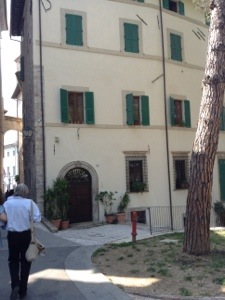
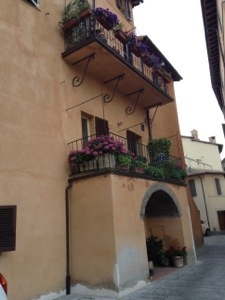
I’ve just included a few random photos of Spoleto, I love the green shutters on the buildings. Blue shutters in Greece, green in Spoleto.
More tomorrow.
SPOLETO DAY 4
Debussy, A Roman Ampitheatre and The Tempest.
SEE THE WORLD AND SEE WORLD THEATRE
A very hot day which started for me with a lunchtime piano concert in the Teatro Caio Melisso, an opera house originally built in the 17th century and remodelled and renamed after a Spoleto writer in the 19th century. It is on a much grander scale than the Bevagna theatre, and as the second opera house in Spoleto it was instrumental in Menotti’s decision to reside in Spoleto and to establish the festival here. The photos show the highly decorated cloth and the Roman theatre masks on display in the foyer. The music was charming and included works by Debussy and Satie.
The remainder of the afternoon, I devoted to locating the Roman ampitheatre. In the heat I walked for ages thinking I was going to discover a ruin similar to the ampitheatres in Greece, but not so. As I got to the lower part of the town, I could trace the town wall, discovered the empty moat and some Cyclopean walls similar to those on Agamemnon’s palace. Walking alongside the city wall, it eventually became evident that this was a part of the ampitheatre and that what I was looking at was a colosseum type of building that presented spectacles including the martyrdom of St Gregory.
Anfiteatro Romano – MySpoleto http://www.myspoleto.it/citta/…/Anfiteatro-Romano.html – confirms it was a site for gladiatorial games and seated 10,000 people!
I’ve taken a photo of the street sign because it took me so long to find, but what a find, a colosseum/ampitheatre that is in the process of being restored. It is not in my theatre research unless I can establish that plays were performed here, but a gem nevertheless. Other photos are of the walk and the shady respites along the way.
The 1st century AD ampitheatre beside my hotel, had not only collapsed in the terrain but had been engulfed in the adjoining monastry and then a prison until 1954. It has finally been restored and unveiled as a ballet and concert performance space.
penelope.uchicago.edu/Thayer/E/…/Spoleto/Spoleto/Roman/theatre.html elucidates on the rarity of the paving on the stage, which I have not seen, as it is well covered.
So where does this lack of continuous theatre performance lead me? … to Merida in Spain! Closer to Lisbon than Madrid, it is the site of one the most authentic extant Roman theatres in Europe with all the features of the changes in theatre architecture associated with the Roman developments in theatre. I will be visiting it on the last leg of my journey to see Apuleius’ The Golden Ass. And although I knew of the existence of the theatre, my discovery of The Merida Classical Festival came as one of those freakish things that happen when one is surfing the web. So it this site that I will be exploring in the link between Greek and Roman Theatre long before Italian theatre developed its mystery plays and of course, Commedia del’ Arte – all of which came later- and which in due course, I will explore.
But for now, back to Spoleto and the main reason I am here, even if it is yet another variation in the development of theatre, is to See the World and See World Theatre.
And here, on Day 4 I witnessed exactly that.
Irina Brook is the daughter of the esteemed director and theatre academic, Peter Brook, and as well as being an actress in her own right, she has become an esteemed director, working with Mnouchkine and in developing her own works.
en.wikipedia.org/wiki/Irina_Brook provides a good overview of her work.
With an early evening tempest hitting Spoleto, I borrowed an umbrella and headed up the hill to San Simone to enter the dilapidated medieval church that is now mostly used for performances. And what a great space to house Brooks’ Island Trilogy: The Tempest, The Odyssey, and The Isle of the Slaves.
This evening I was seeing The Tempest and as soon as I entered the dark and gloomy space, I could see the Mnouchkine influence. Pockets of the huge church were scenic display areas. One was a beached and overturned row boat over which young children were playing. Another was a deckchair, a beach umbrella and a young piano accordionist providing jaunty tunes while we queued for the scaffold seating before us and lastly, a somewhat insignificant ladies dressing table and mirror with an empty suit case strewn on the sandy floor.
Sand was everywhere and as we made our way into the playing space we were on an island. One of the players was cooking a meal amongst the immense paraphernalia on a kitchen table. A young woman was writing on a pillar and two surly males were huddled in a corner, one trying to unravel a fishing net, the other being incredibly still.
When the play flew into action, Prospero, is an Italian restauranteur, Ariel, his flashy Maitre D, the fishing net unraveller is Caliban and of course the beautiful young woman writing poetry on the wall is his daughter Miranda.
The play, in French with Italian surtitles, plus some English is a magical romp that only occasionally uses the Shakespearean text and often injects other Shakespearean and Byronic quotes. It is all a truly delicious, magical mayhem. The cast is wonderful, especially Miranda and Caliban and the range of genres that the work employs ranging from hip pop to waltz to replay parody a la Buster Keaton was a delight….in fact it was one delight after another. I congratulated Ms.Brook after the show and she told me it had been 2 years in development in France and that The Odyssey had been 10 years in development. What a marvellous accomplishment. I see both The Odyssey and the Isle of the Slaves on Day 6. I can’t wait to see how she again utilizes the space and how the actors adapt so quickly to two new plays. This production of The Tempest is a must see and I hope it gets picked up for the Melbourne Festival some time soon.
PORNOGRAPHY by Witold Gombrowicz
This was a programme I chose from a deep resistance to the subject material and because I knew very little about this acclaimed Polish writer.
en.wikipedia.org/wiki/Witold_Gombrowicz
My first surprise came when I realized that the theatre for this event, Teatro Francesco Torti of Bevagna was not on the Spoleto map. Where is Bevagna?’ I asked the incredibly helpful Festival Office attendant, ‘in the country’ was the reply, ‘but there is a festival bus to take you there, however you need to book 48 hours in advance.’ I’ve encountered a couple of examples of this sort of bureaucracy in my travels and managed to solve it with a big smile and pleading the ignorance of a foreigner. Anyway, Chiara secured a seat on the bus and in the meantime I took advantage of a free concert in the Largo Di Clementi. It was a 6 piece wind ensemble with the emphasis on saxophones of all sizes plus a clarinet made of gold. When the concert finally got under way, the music was charming.Then off I went to Bevagna with another 60 or so Pornography revellers.
Once more the countryside was beautiful with fields and fields of sunflowers in the 7 pm sunshine.
Arriving at Bevagna was like arriving on a film set that one had seen many, many times.
The town is medieval and Teatro Francesca Torti absolutely amazed me. I am told that these sorts of theatres exist all over Italy, but for me it was a first in that it was a provincial Teatro and did not have the gaudiness of Renaissance theatres. I had booked a ticket in the gods as this production was not high on my list of must-sees, and on arriving in the dizzy and hot heights of Loggione, I was greeted by a swathe of Roman murals on the ceiling and walls. The charming Senorita, informed me that if the theatre was not full I could venture down to the stalls. This I did, prompted by a Philosophy student, and I ended up in a box! What an adventure.
And then 3 hours of the play, thankfully with an interval, when I crossed square for a gelato. Pornography is set during WW2 and is more a question of voyeurism than pornography. As an adaptation, and an Italian premiere, I believe it could benefit from concerted cutting. One delight for me was the use of the tracks in the stage which could make items of furniture and other paraphernalia appear and disappear at will.There was a performance by a strikingly attractive 40-something woman that was a standout. Not only did she shake with every fibre of her body to indicate her state of anxiety, she later appeared totally naked and blood smeared as a victim of rape and murder. That performance was truly arresting.
In my initial research tracing the development of theatre from Ancient Greek to Ancient Roman theatre, I had been unsuccessful in locating any extant theatres of the medieval period in Italy, let alone theatres presenting early Roman or Christian material. So here I was in a 251 seat Medieval theatre that had been beautifully renovated in the 19th century. Mr Google translated some details for me:
Teatro Francesco Torti, Bevagna
Piazza Filippo Silvestri 06031 BEVAGNA PG Tel 0742 368123 Fax 0742 361647 Type: Theatre E-mail: pbevagna@bcsnet.it – sociali@comune.bevagna.pg.it Disabled access: YES Monumental building: YES Visits: YES Capacity seats: 251
Where is
Torti The theater is located in the main square of Bevagna , a charming medieval village situated on a small hill at the western edge of the Umbrian Valley.
Today the theater is part of the Circuit City Museum which includes a visit to the Museum and the Mosaic of the Roman Baths . In this circuit, recently, it has been joined another, the Cultural Crafts Medieval , with separate ticket or cumulative.
It was once
The theater is housed in Palazzo dei Consoli, built in the thirteenth century.
On the ground floor is still the loggia, covered with three large Gothic arches and a quarter smaller, probably used as commercial space.
Why visit
One of the smaller theaters of Umbria, only 251 seats, is dominated in its limited size by harmony and perfection.
Tastefully decorated, contains interesting paintings nineteenth century, the particular location within a historic building nell’asimmetrica Piazza Silvestri, makes the visit even more striking.
Description
Made in 1886 by architect Antonio Martini, is named after the local scholar Francesco Torti.
The theater has a plant in a horseshoe, three tiers of boxes and a loggia; railings are made from cast iron columns.
The ceiling is the work of Mariano Piervittori and represents the Muses dancing. The original curtain was painted by Domenico Bruschi with Propertius Torti who points to his homeland in 1886 during the restoration of 1994 was another curtain created by the painter Luigi Frappi Bevagna with’ll Clitunno river with poetic and memorial temple.
The coat of arms above the curtain in 1380, donated by Pope Innocent IV, it states “OSF”, which stands for “Ob servatam Fidem.”
After the structural restoration, the theater is regularly active.
Curiosity
The construction of the theater was strongly supported by the citizens who in 1871 had gathered in an organizing committee. The inauguration took place on the evening of August 28, 1886, for the occasion, the impresario Alfredo Wolves staged the ‘Ernani, along with The boarders of Sorrento.
OK so I saw a 20 century piece of theatre, but just finding the theatre was gold and I would certainly include it as a must see if organising a tour. I think this is the first time the theatre has been utilized in the Spoleto Festival but wouldn’t it be great if they could stage a medieval piece in there? Perhaps some of my actor friends and I could do it under Angela O’Brien’s theatre history
guidance.
Any of my theatre cronies up for it? 🙂
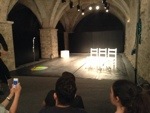
Spoleto, set high in the hills of Umbria couldn’t represent a greater contrast from Greece. Arriving in this Roman town with it’s winding streets, tall stone buildings, magnificent architecture, plazas, and beautiful pot plantings on a busy Sunday afternoon, one was struck by the sophistication of the place boasting one of the finest art festivals in the world. Spoleto, The Festival of Two Worlds. The bunting promotion in association with Mercedes Benz in the central plaza states ‘ Art or Nothing.’ A browse through the historical literature reveals that the city has a pre-Roman existence going back to the 10-11 century BC. It was a colony in 241BC and a municipium in 90BC. In the light of this knowledge I am interested to trace the origins of the local ampitheatre to explore the theatre productions which took place here. A small Roman theatre abuts my hotel. Please forgive my getting so absorbed in my research that I tend to overlook expressing the sublime beauty of the countryside. The light here is soft and often hazy and on several occasions there has been afternoon thunder and light rain. The sophistication of the place extends to the attire of the locals. They are so well turned out. Even the young concierge in the hotel looks like he has stepped out of a high couture journal. Magnifico! Women are highly adorned with jewelry, impeccable make up and casual doesn’t seem to be part of the dress code. I wonder how they manage the cobble paving in their smart shoes… I had intended to have a little rest in Spoleto after the somewhat hectic pace in Athens and the plays I have chosen to see are well spaced throughout the week. However, as always, I couldn’t help myself, and on Day 2, I found myself at an exhibition production of the European Youth Theatre featuring students from the Conservatoire National Superieur D’Art Dramatique. It was a dramatic adaptation of Dostoyevski’s 1877 short story,The Dream of a Ridiculous Man. The play took place in a crypt of one of the many churches and grand public buildings. I hope the photo shows the beauty of the vaulted ceiling. It’s always good to support newcomers to the craft and throughout the festival, Spoleto provides the opportunity for European Acting Academies to present their talent. As well as encouraging new talent, I always make a determined effort to see I work I don’t know, as was the case with this Dostoyevski. It’s about his realization, since a small child, that he was ridiculous and that ultimately there is nothing worthwhile in life and therefore he must commit suicide. Presented as a 3-hander, by the plays’ end the actors had managed to seduce sufficient numbers of the audience to take their places in the playing space, and then exiting, thus making them (the audience/everyone/ tout le monde) ridiculous. Being in French it was relatively easy to follow the narrative. Back at Hotel dei Duchi for dinner, I’m watching the palest of sunsets disappearing behind the Umbrian mountains. The Golden Hour has been magical and the light here is soft an enchanting. It is a soft landscape particularly after the ruggedness of Greece. The light is more gentile and the sun a little kinder. Once more, I am reminded of my thesis and how art, whether theatre, painting, music, dance, literature and even cinema, is born out of place. I’m very excited to explore Spoleto and the festival offerings. Clearly it is a very important event in the year and as yet I’m having difficulty in identifying the locals from the art lovers coming from afar. There is so much going on in a quiet and unassuming way, everywhere you turn you find plazas set up for events, some of them free and at all times during the day and evening. Some events are even out of Spoleto in the countryside. Finally, I feel compelled to make a comment with regard to a comparison of the Spoleto Festival we used to have in Melbourne,which from my memory was more of a street festival. This is not the case in Umbria.
Athens Day 5 Island Hopping and Iphegenia in Aulis
This is a photographic record of an Island Hopping Tour. The Greek Islands are everything everyone says about them and there is nothing other than to experience them for oneself.
Iphigenia in Aulis, once more a postmodern interpretation, highlighted Euripides’ doubt in the current status quo. The play is regarded as an ironic drama and this production was certainly played for humour and the audience responded with guffaws of laughter.
The setting is the port of Aulis where Agamemnon and his army are setting sail for Troy to recapture Helen. However, Artemis has becalmed the seas and requires a sacrifice to enable the army to get under way. http://www.ancient-literature.com/greece_euripides_iphigenia_aulis.html provides a very good synopsis of the plot.
As an aside, it seems that Aulis is a port in Thebes, where I passed through yesterday.
The staging has the sensibility of down and out. There is a metal watch tower, discarded and dysfunctional shipping apparatus, small sand dunes which provide isolated performing areas and strips of shallow water.
The actors were attired in modern dress and the chorus in this production consisted of two flapper-style bathing beauties who decorously draped themselves amongst the sand and watery shallows.
On another note, I couldn’t help but wonder if the play could be interpreted as a parody on Greece’s currently becalmed financial situation and what sacrifices are needed to change the tides of good fortune.
My lack of Greek did not impede comprehension of this piece and while knowing the story helps, it was the production design, direction and attention to detail that captured my attention and my admiration. Agamemnon was a sorrowful fellow with a big problem. Iphegenia was a fey young women, who went to her sacrifice like a lamb to the slaughter – please pardon the cliche, sometimes they are useful.
The first time director, but acclaimed actor, Maria Protopappa, did not entertain any histrionics and the beauty of the text was apparent by each of the actor’s complete and unselfconscious immersion in the narrative. I do like listening to Greek when delivered well. There is such charm and power in the sounds and phrasing.
This production, also in the industrial conversion space, utilized the emptiness of the space with its most engaging set. Again, the audience loved the show; they laughed heartily, we’re incredibly silent in the most intense moments and erupted into wondrous applause at the play’s conclusion. It is becoming more and more apparent just how important the arts are to the locals and I consider it a great privilege to be a part of such appreciation.
THE THEATRE OF APOLLO AT DELPHI
Today I utilized the knowledge and experience of a conducted tour, and as I had already seen the main Festival offering, Ibsen’s, An Enemy of the People, at the 2012 Melbourne International Arts Festival, I opted for a leisurely Greek taverna dinner with an Athenian friend in the evening.
The exceedingly well organized tour was headed by an exceptional guide who cheerfully imparted her wealth of historical, mythological and topical material. Leaving Athens, the bus took a 2 hr drive through its urban sprawl, fertile plains and seaports, into the dizzying heights of the mountains. Amongst the urban sprawl was the location of Marathon, the plains of Thebes, the Sanctuary of Olympia, the site of The Muses, and the Temple to Demeter, which is of great interest to me as it is the Temple associated with the Mysteries School.
In terms of Greek Theatre, David Wiles has devoted a good deal of scholarship to the notion of the significance of place. Indeed this was an element I engaged in my own Masters thesis in as much as a playwright will make reference to a place and by association, the audience will appreciate the deep meaning. Although associations of place had already been aroused in me, in view of actually passing through the places encountered in ancient literature, it is an area I would like to explore in my future studies of Greek drama texts.
The Temple of Apollo is located on Mount Parnassus. The extraordinary rugged beauty of the place in high summer belies its existence as a winter playground for cross country skiing and snowboarding and other snow activities I know nothing about!
Arriving at the Temple of Apollo, and passing through the agora, one is seemingly greeted by the imposing columns of the altar at the entrance to the temple, and at which, supposed sacrifices took place prior to performances in the theatre.
Theatre, according to one source, http://www.coastal.edu/ashes2art/delphi2/sanctuary/theatre.html, was a sacred act with the priest of the temple officiating. Actors were also sacred and highly revered, and from my observations, this attitude seems to persist amongst modern Greeks.
The ampitheatre, which seats 5000, is well preserved and overlooks the The Temple. As the patron of Delfi, Apollo is the god of light, music, poetry, healing, prophecy and more, and is the twin brother of Artemis, goddess of hunting. http://en.wikipedia.org/wiki/Apollo, gives an excellent account of Apollo’s duties as the Patron of Delphi/Delfi and also makes clear the positioning of Delphi as the navel of the world. Indeed the ancient ompholos is represented by a concrete replica on site with the supposed original ? or at least, another replica housed in the site museum.
Our guide explained that the site is exceptionally high in magnetic energy, which in turn, is associated with prophecy. I watched as a tourist carefully placed his hands on the concrete ompholos and I hope he was blessed with a suitable Delphic response.
When I asked the guide about contemporary use of the theatre, she informed me that several years ago, Vanessa Redgrave had performed Phaedre here. Wow! (even though it’s unsubstantiated.)
The visit to this site has revealed just how much more I want to learn about Ancient Greece. It is very inspirational. For my next trip, I intend to have expanded my knowledge and to have obtained a passable amount of basic Greek. For the most part, people working in museums and tourist places speak English, but everyone responds very well when you greet them with kalimera and acknowledge them with efpharisto.
Dinner in a back street taverna near Monastiraki was wonderful. Angela Makris ordered a wide range of local delicacies ranging from deep fried feta with honey and oregano, local salad, meatballs, and I can’t remember what else. Although I do remember the ouzo. I really enjoy the freshness and relative simplicity of Greek food and the taste of tomatoes and other salad vegetables is very different from Australian salad vegetables. Maybe Greek soil is magic!
Walking through the main streets of Athens at night was without incident and at no time have I felt unsafe.
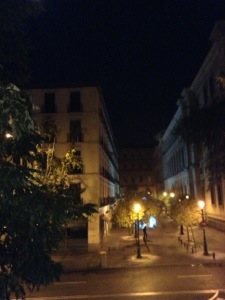
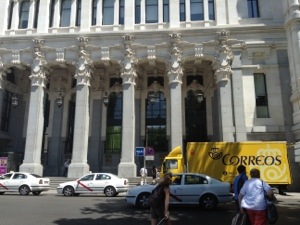
Madrid is really an appendix as I had decided to use my 2 nights here to rest before the long flight home. It is a very grand city indeed with huge boulevards and I’m not altogether sure that it does not surpass London for grandeur of planning and architecture and the location of my hotel was right amongst the museums and galleries.
I was very lucky to even get into the Dali 40 year retrospective across the road and even happier to learn that it was for free. I never did quite work out why. It was sensational, with many of his well known works included plus some cinema which I really enjoyed. Although it was somewhat rushed, which I suppose is why we were let in for free at 7pm and had to be out by 9 … what a thrill to see Dali in Madrid.
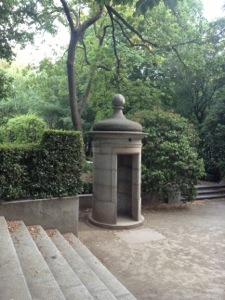
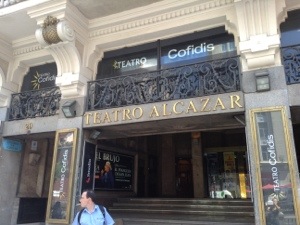
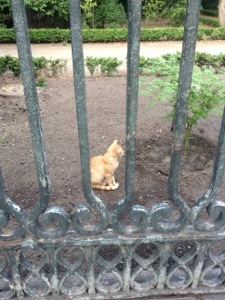
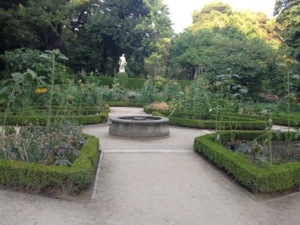
Next I took a walk in the Botanic Gardens which was such a respite from the heat of the day. They are very formal gardens with short box hedging, a ginger cat, and a wonderful veggie garden and then I crashed. What no theatre? you are asking. Uh, uh, it’s summer and theatre is either on holidays or in the provinces. However on the next day, as I was walking to Sol, I passed the Teatro Alcazar and there was a billboard advertising two Rafael Alvarez programmes. The man is a classic of actor /manager, writer/adapter and good on him. Clearly he has found a niche and is giving the public some wonderful experiences of classic texts.
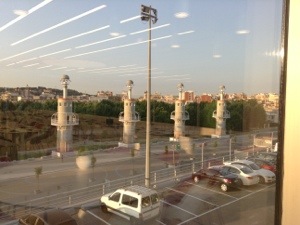
Please enjoy the photos of a very limited account of Madrid. In reality, Madrid has an exceedingly rich tradition of theatre which I hope you’ll explore with me next time.































 brenda addie